
Running Sushi Review: The Belt Prices Every Spin, and Three Collectors Decide the Rest
Running Sushi is Pragmatic Play's five-by-four sushi bar with 1,024 ways and a conveyor of priced plates under the reels. Across three logged demo sessions, 5,938 paid spins at a flat 2.00, the pool came back at 90.32% of its stakes with 21 free spins rounds. This portal's own session, 2,768 paid spins, closed at 85.02%, and its best round paid 276.9 bets.
The belt is the thing to read. On every spin it carries two to ten plates with printed prices, 25.6 bets' worth on average in our log, and three Take Sushi symbols collect the lot. That happened on 20 of 2,768 spins. In the free spins the plates also go into a meter, and three Take All symbols pay the meter out, which happened once in our eleven rounds; every round ended with a sum still on the counter, 4,539 bets in all. This review counts what the belt showed against what it paid.
- Who it suits: players who want a base game that pays on one spin in eight, a conveyor of printed prices under the reels, and a free spins meter they can read plate by plate
- Core mechanic: 1,024 ways on a five-by-four board over a conveyor of two to ten priced plates; three Take Sushi symbols collect the belt, and in the free spins a meter banks every plate until three Take All symbols land
- Key risk: the belt showed 25.6 bets a spin on average and paid out on one spin in 138 in our log; all eleven rounds closed with a sum on the free spins meter and only one paid it out; the volatility label changed from High to Low between May and October 2026
- Rating: 6.8/10
Game Information
90.32% tested, pooled on paid spins
276.9x tested, best full round (all sessions)
Where the stated figures come from
| Figure | Value | Source | Checked | In the tested build |
|---|---|---|---|---|
| Stated RTP | 96.00% | In-game rules, page 4 of 7: 96.00% for normal play, the ante bet and the bought round; the studio's game page prints the same 96% (game page) | public demo 12 October 2026; archived screens 25 May 2026; studio page 12 October 2026 | Yes: printed in the rules, and the game's first response on 30 July 2026 carried the same 96.00 for all three modes |
| Advertised max win | 3,000x | In-game rules, page 3 of 7: the maximum win amount is limited to 3,000x bet and a round that reaches it ends; the intro screen says win up to 3,000x bet | public demo 12 October 2026; archived screens 25 May 2026 | Yes: printed as a cap that ends the round, 3,000x on the normal stake and 2,400x of the ante stake in the game's own settings |
| Volatility | Low | In-game rules, page 4 of 7, and the intro screen, both read on 12 October 2026: Low volatility; the same page archived on 25 May 2026 showed five lightning bolts and a line about high volatility | public demo 12 October 2026; archived screens 25 May 2026 | Yes, with a caveat: the label changed between May and October 2026 while the printed return and the cap did not |
| Bonus trigger | 3 scatters on reels 2, 3 and 4 for 10 free spins | In-game rules, page 2 of 7, restated on our rules page (rules page) | public demo 12 October 2026 | Yes: printed in the rules, with no retrigger rule and none seen in 21 logged rounds |
| Buy price | 85x the stake | In-game rules, page 3 of 7, and the button on the left panel, 170.00 at a 2.00 stake; the ante bet raises the stake by a quarter and switches the buy off | public demo 12 October 2026 | Yes: printed on the button and in the rules; no round in the three logs was bought |
| Release date | August 8, 2024 | The studio's launch announcement of 8 August 2024, which presents the game as its latest release; the studio's game page prints no release line, and the build prints no date and no version number (announcement) | announcement and studio page 13 October 2026 | No: nothing printed in the build |
Where a figure is our reading of a source, the row says so.
A belt that prices every spin, and three collectors that decide the rest
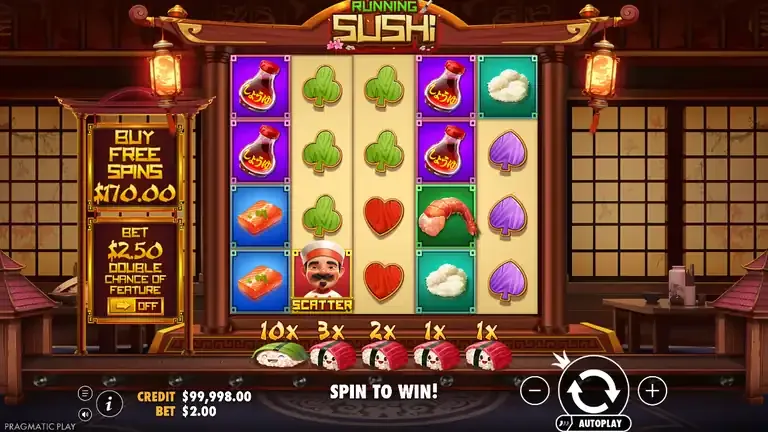
Under the reels of Running Sushi a conveyor runs on every spin, and every plate on it carries a price in bets. The rules print the list in full, 26 values from 1x to 1000x the base bet, with 2500x added inside the free spins. In the base game three Take Sushi symbols on the first, third and fifth reels collect the belt of that spin. In the free spins the plates also go into a meter, and three Take All symbols on the middle reels pay the meter out. The belt in our log carried 5.45 plates a spin on average, worth 25.6 bets, and over 2,768 paid spins it showed 70,817 bets in prices. Twenty spins collected it, and they took 431 bets between them, well under one percent of what the belt had displayed. The eleven free spins rounds told the same story at a larger scale. Eight Take Sushi collections inside them paid 363 bets of belt and one Take All paid 217 bets of meter, while every one of the eleven ended with a sum still on the meter, 4,539 bets in all.
On paper, then, the game is a shop window with a lock on the door, and the rules give no rate for the key. In the sample, the base game still paid on one spin in eight and gave back 55.60% of the stakes on its own. The fish of Big Bass Bonanza 1000 managed half of that for the same studio. The feature arrived eleven times in 2,768 paid spins and paid 34 bets at the median. One round on the 238th paid spin returned 276.9 bets, the best complete round of the three-log pool. This review counts the belt against the wallet, and the count comes in three parts. The first is a display that prices every spin and pays a sliver of it, the second a meter that was paid out once in eleven rounds and wiped eleven times. The third is a label that went from High to Low between May and October while the printed return, cap and prices stood still.
What this page cannot show
A single log of this length settles no long-run figure, and adding two more does not settle one either. The clock of the feature stays loose on eleven rounds: at the 95% level it sits anywhere between a round every 141 paid spins at one end and a round every 504 at the other. The pool's 21 rounds narrow that band only as far as 185 at the fast end and 457 at the slow end. No weight is printed for any of the 26 plate values and no rate for three collectors on one board, so the counts below describe three afternoons and price nothing. Across 5,938 pooled spins no plate above 300x reached the belt, and the five larger values on the rules page stayed there, a zero that counts something and proves no rarity. Nobody pressed the ante toggle or the buy button in the three logs, so a bought round has no price in this book. Every figure below is demo credit, taken from how the game settled each spin, with one frame kept per second, and a collection can land between two frames.
Twenty collections in 2,768 spins, and a belt worth 25 bets a spin
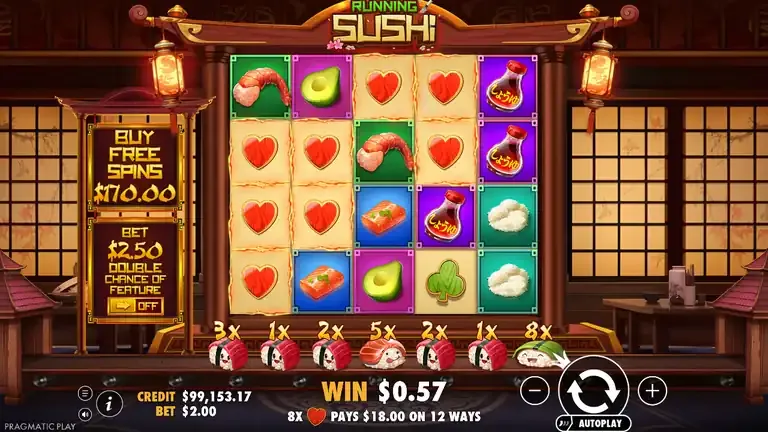
The base game runs 1,024 ways across five reels of four and pays from the leftmost reel inward. Ten symbols fill the paytable, a hot sauce jar at seven and a half stakes for five of a kind down to a clover at a quarter of the stake for three. Seven of the ten return less than the stake for three in a row. The belt below them is the other half of the board, in my reading. Two to ten plates appear on it every spin with a price drawn for each, and three Take Sushi collect the lot. Our log held 344 paid spins with a base-game payout, 12.43% of them, and 313 of those returned the stake or more, 11.31% of all spins. Two bets was the median base-game payout, 4.00 at our stake, and the mean was 8.95. Twenty spins collected the belt, one per 138, for sums from 18.00 to 116.00. Those twenty paid 862.00 together, 28.0% of everything the base game returned, with the ways wins supplying the rest.
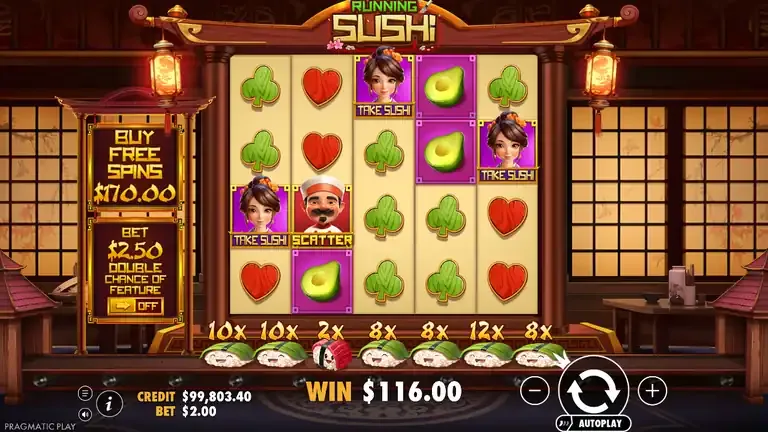
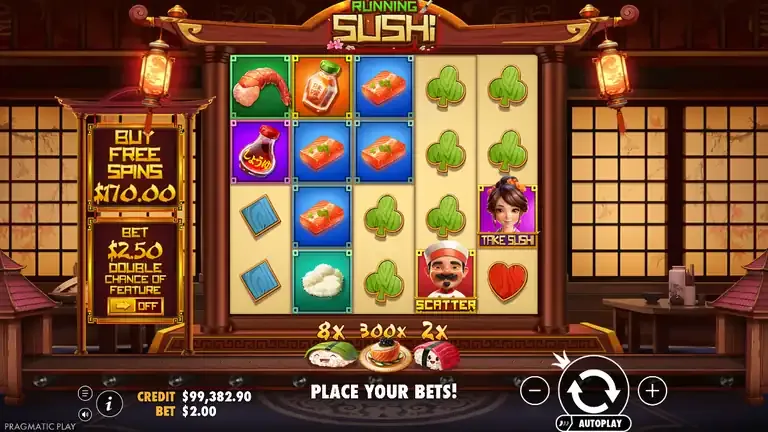
The strongest base-game spin in the log was a collection, on the 1,128th paid spin, three Take Sushi over seven plates worth 58 bets. The game paid 116.00 for it, and the meter rose to 99,803.40 on that spin. The strongest ways win was 96.00, 48 bets, on the 2,534th spin, and the third best base-game spin of any kind paid 72.00. Set against those twenty collections are the belts that passed with nobody to claim them. The largest of them carried 310 bets on the 2,285th spin, a 300x plate flanked by an 8x and a 2x, with a single Take Sushi on the board. The next two carried 257 and 229 bets, and both passed the same way. In 2,768 spins the belt showed one 300x plate and four of 250x. No plate above 300x turned up in any of the three logs, base game or feature. Forty-one spins was the longest run without a payout, and a paying spin arrived every 7.8 spins on average. Of the 5,536.00 staked, the base game returned 3,078.10 by itself, 55.60%, and the sister logs returned 57.36% and 71.33% of theirs the same way. A base game paying one spin in eight at two bets a median moves slowly, and this one keeps a menu under the reels that it serves once in 138 spins.
Ten free spins, a meter, and three Take All that have to land
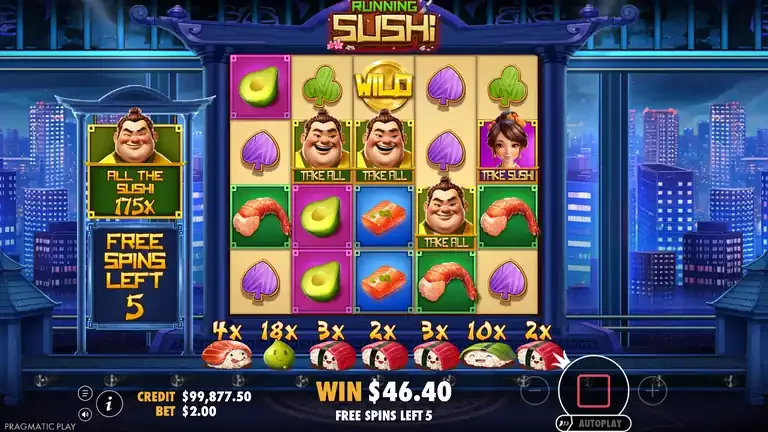
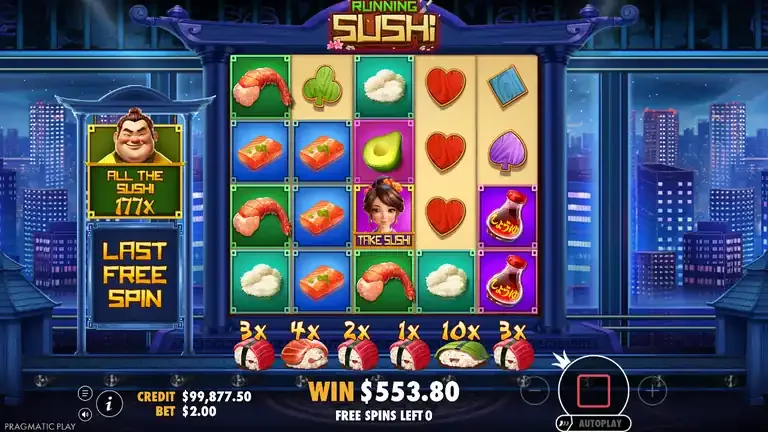
Three scatters on the middle reels open ten free spins, and all eleven of our rounds came on exactly three because the scatter lives on three reels only. Inside the round the belt keeps its collector and gains a second one. Three Take Sushi still pay the plates of that spin, and every plate that appears also goes into a meter on the left of the screen, paid or not. The wild joins the middle reels, and Take All appears there too. Three Take All take the whole meter, that spin's plates included, and the meter starts again from nothing. The rules print no retrigger, and the 21 pooled rounds never added a spin. The rules also say nothing about a meter that no Take All reaches, so the log has to answer that one: when the tenth spin settles, the meter is gone. All eleven of our rounds closed with a sum still on it, 9,078.00 in all, 4,539 bets, and six of the eleven collected nothing at all. Those six left 4,882.00 on their counters, 2,441 bets, and paid between 8.7 and 34 bets from ways wins and the trigger spin's own line.
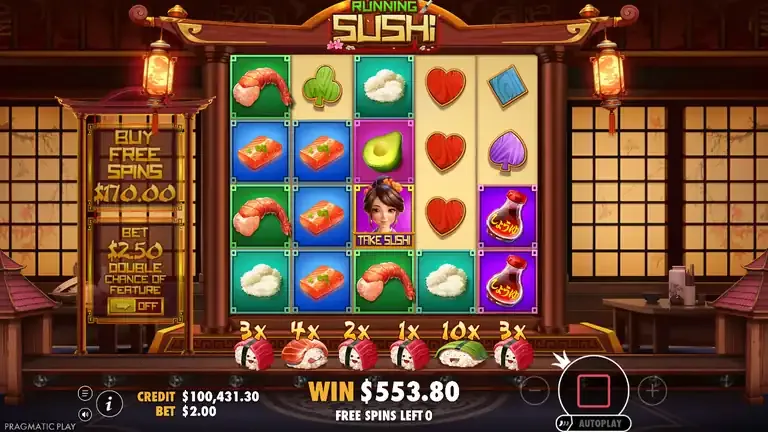
Eleven rounds across 2,768 paid spins come to one every 252 (n = 11), with waits between them from 36 spins to 583. Five rounds landed a collector at least once, nine collections worth 1,160.00 between them, and those five paid from 77.7 to 276.9 bets. Only one of the nine was a Take All, the 434.00 that made the best round, and the other eight were Take Sushi paying the belt of their spin, 726.00 in all. The six rounds without a collection paid from 8.7 to 34, a range that ends well below where the other begins. The median round paid 68.00, 34 bets, and the mean came to 74 because two rounds past 165 bets dragged it upward. The log's largest free spin paid 435.60 inside the best round. Three Take All landed on its fifth spin with 350.00 on the meter and 84.00 of fresh plates on the belt. The largest meter left behind was 1,196.00, 598 bets, in the seventh round. It had collected the belt once, 112.00 with three Take Sushi on its seventh spin, and a Take Sushi leaves the meter untouched.
| Round | Trigger spin | Take Sushi inside the round | Take All | Meter left at close | Full round | ×bet | Best free spin |
|---|---|---|---|---|---|---|---|
| 1 | 184 | 2 for 136.00 | none | 766.00 | 155.40 | 77.7x | 108.00 (spin 6) |
| 2 | 238 | none | 1 for 434.00 | 354.00 | 553.80 | 276.9x | 435.60 (spin 5) |
| 3 | 411 | none | none | 592.00 | 36.80 | 18.4x | 31.50 (spin 6) |
| 4 | 447 | none | none | 1,034.00 | 28.50 | 14.25x | 18.50 (spin 7) |
| 5 | 766 | none | none | 968.00 | 17.40 | 8.7x | 7.50 (spin 1) |
| 6 | 1,349 | 3 for 314.00 | none | 856.00 | 331.10 | 165.55x | 125.00 (spin 4) |
| 7 | 1,386 | 1 for 112.00 | none | 1,196.00 | 175.50 | 87.75x | 112.00 (spin 7) |
| 8 | 1,590 | 2 for 164.00 | none | 1,024.00 | 174.50 | 87.25x | 100.00 (spin 4) |
| 9 | 1,937 | none | none | 582.00 | 57.00 | 28.5x | 53.00 (spin 7) |
| 10 | 2,234 | none | none | 858.00 | 30.50 | 15.25x | 12.00 (spin 6) |
| 11 | 2,680 | none | none | 848.00 | 68.00 | 34.0x | 7.00 (spin 2) |
Trigger spins are numbered in paid spins, counted from the log's first stake. The full round is what the wallet gained at the moment of the credit, with any ways win of the triggering spin inside it. Two triggering spins made one, 3.00 in round 2 and 54.00 in round 11. The meter column gives the counter's reading when the tenth free spin settled, taken from the game's own responses, and that sum was not paid. A Take Sushi inside the round pays the belt of its spin and leaves the meter as it was.
The round is short, and its one question is whether three Take All arrive before the tenth spin settles. A board with three Take All pays whatever has accumulated, and a board with three Take Sushi pays the belt of that spin while the meter goes on growing. A board with neither pays the ways and keeps the plates in view. Whereas Big Bass Bonanza 1000 lets every wild collect and then steps a multiplier for the later ones, this build asks for three symbols at once and multiplies nothing. In the pool twelve of 21 rounds collected something and nine collected nothing, but only two of the 21 landed three Take All. The two Take All paid 750.00, the sixteen Take Sushi inside the rounds paid 1,842.00, and the meters wiped at the close came to 18,084.00, seven times what both collectors took and twenty-four times what Take All took. The meter is the feature's whole promise, and the logs say it was paid out twice in 21 rounds.
Three ledgers, 5,938 paid spins
The SlotLab testing team holds three Running Sushi ledgers, the longest of them this portal's, filed under Session ID RUSH-20260730-01. The other two date from 26 June 2026, logged at 2.00 as well, ante off, nothing bought. One of them is the session that runningsushislot.net publishes beside its demo. The other is a second June log of the team that no site carries, pooled here because the pool takes every ledger on file. runningsushicasino.com, the network's other dedicated site, carries a 1,440-spin session on its page, and that ledger isn't on file. Its figures appear below as published and stay outside the pool. Every ledger counts paid spins alone, since the free spins cost nothing, and every balance comes from the game's own settlement, which makes pooling plain addition. Together the three staked 11,876.00 across 5,938 paid spins and got 10,726.20 back, 90.32%. The 21 rounds come to one every 283 on the pooled count, with a 95% band between 185 and 457 spins per round. This portal's 276.9 bets is the pool's best full round, and a 96-bet ways win in the published sister log is its best base-game spin.
| Source | Spins | Observed return | Feature rounds | Best full round | Net result |
|---|---|---|---|---|---|
| CasinoReview.click | 2,768 paid | 85.02% | 11, one per 252 | 276.9x, one Take All | −829.40 |
| runningsushislot.net | 1,623 paid | 122.34% | 8, one per 203 | 253.3x, one Take All | +725.30 |
| SlotLab testing team, second June log | 1,547 paid | 66.20% | 2, one per 774 | 116.75x, one Take Sushi | −1,045.70 |
| Combined | 5,938 paid | 90.32% | 21, one per 283 | 276.9x, full round | −1,149.80 |
The table uses one measure throughout: paid spins at 2.00 and a full round valued as the wallet's gain at the instant of the credit. The runningsushislot.net page carries the same spin count and the same round count. Its headline 122.31% comes to two decimals from a closing balance read one spin earlier, and its best round is listed at 242x where the full ledger credits 506.60, 253.3 bets. The runningsushicasino.com page describes a 1,440-spin June session with eight rounds, a 177.1x best and a return the page itself rounds to 98%, figures this page quotes and cannot check. The Combined line divides the sum of the three returns by the sum of the three stakes.
CasinoReview.click Erik Lindholm's log · July 2026
runningsushislot.net Mia Stone's log · June 2026
SlotLab testing team second June log · June 2026
One log lost a seventh of its stakes, one won a fifth and one lost a third, and the rounds explain most of the gap. The published sister log met eight rounds in 1,623 spins and collected in six of them, 1,206.00 in all. Its best round opened on the 1,492nd paid spin, and the only Take All of that log, on the third free spin, paid 316.00 of its 506.60. The second June log met two rounds in 1,547 spins, 720 spins apart, and its base game carried the whole afternoon on its own. Hit frequencies sit within three points of each other across the three logs, 12.83%, 13.25% and 10.99%, and the base games returned 55.60%, 71.33% and 57.36% of what they staked. The gap between the logs is how many rounds came and whether a collector landed inside them, and a few thousand spins put no price on either.
RUSH-20260730-01 · Evidence retained: 9,577 timestamped frames plus the full session log. Read the session report: RUSH-20260730-01. Frames beyond its tables are available on request through the contact form.
The return, printed three times, under a label that moved
Page four of the rules puts the theoretical return at 96.00% and prints the same figure for the ante bet and the buy. The game's page at pragmaticplay.com shows the same 96%, and what changed is the label above those lines. On 25 May 2026 the archived page carried five lightning bolts and a line about high volatility. On 12 October 2026 the public demo printed Low volatility there and on its intro screen, with a line about frequent smaller pays. The game's first response to our session on 30 July carried the same three return figures, the same limit and the same buy price as today's demo. Those printed values matched in every copy checked, and they alone do not establish that the probabilities behind the label were unchanged. This portal's session returned 85.02% of its paid stakes, the published sister log 122.34% and the second June log 66.20%, three afternoons the game owes nothing to. Three results bound no fourth, and I would expect nothing from a fourth log beyond one more afternoon.
The printed figure only matters where your casino runs that same setting. Pragmatic Play sells its games in more than one return setting, and the operator chooses. The binding number is therefore the one printed by the build you have open. This demo printed 96.00%, while a lobby copy may show less, and the belt, the meter and the three collectors would look the same on both.
Editor's note: reading the RTP numbers. The stated return for this title is printed in the game's own rules, 96.00% on the fourth of seven pages, in three modes, and the same figure sits on the studio's game page. Our tested figure is the pooled return of the logged demo sessions behind this review, so the two numbers answer different questions, and even a pooled sample of a few thousand spins is not the game's long-run maths. By money it is 10,726.20 returned over 11,876.00 staked on paid spins across three sessions, and this portal's session alone returned 85.02%. Live RTP is an operator choice: many games ship in several RTP configurations and the casino picks which one to run, so always check the RTP in the game's info screen before you bet real money. More in our guide to observed and stated RTP.
The ante bet and the buy button, priced on the screen
The left panel sells two shortcuts, and both prices stand on the panel in the current stake. An ante bet lifts the stake by a quarter, 2.50 against our 2.00, which the rules express as a bet multiplier of 25 in place of 20. In the rules' wording the chance of a natural trigger is doubled, more scatters sit on the reels, and the buy button goes dark. The buy needs the ante off, costs 85 bets, 170.00 at our stake, and opens a round on the next spin. The rules don't say how many scatters the bought spin lands or what the meter holds when it starts. The game's own settings add a line the screens leave out, a limit of 2,400x on the ante stake, the same money as 3,000x on the normal one. All 21 rounds in the three logs arrived naturally, with neither switch on, so this book carries no price for a bought one. What the button buys is a round, priced at the stakes of 85 spins against a pooled clock of one natural round per 283 spins, and the logs say nothing about which costs more in money. The pooled logs paid out the meter of a round twice in 21 rounds.
Big Bass Bonanza 1000, the same idea with a fish instead of a belt
Big Bass Bonanza 1000 is the nearest relative on our shelf, from the same studio, and the two builds share one habit. Both print money values on the screen and pay them only when a collector arrives. In the fishing build the values sit on fish inside the reels, a wild gathers them inside the free spins only, and every fourth wild adds spins and lifts a multiplier. Here the values sit on plates under the reels on every spin, three symbols at once do the collecting, and nothing multiplies. Consistent with that difference, the two base games part ways at once. Big Bass Bonanza 1000 paid on 11.95% of its base spins, the stake or more on 7.00%, and returned 29.74% of its stakes on its own. Running Sushi paid on 12.43%, the stake or more on 11.31%, and returned 55.60%, because its collector works in the base game as well. The rounds run the other way, and the clocks say how far. The fishing build's log met 27 rounds in 2,870 spins, one per 106, while this one met eleven in 2,768, one per 252. On the pools the two clocks read one per 103 against one per 283.
Where the two builds meet is the shape of a round, decided by one event in each. A lit badge decides it over there, and a collection inside the round decides it here, three Take Sushi for the belt or three Take All for the meter. The rounds that got the event paid from 52.4 to 217.2 bets in the fishing log and from 77.7 to 276.9 in this one. The rounds that went without paid 13.2 to 42.4 there and 8.7 to 34 here. The fish build prints 20,000x as its cap and this one 3,000x, and the pools reached 1,141.8 and 276.9 of those. Big Bass Bonanza 1000 holds a 6.6 on this portal for a dull base game and a thousand it prices and never times. This build keeps its base game alive and prints a far smaller cap. It also sells its own thousand on the belt, a plate that no log of 5,938 spins ever saw.
What the player sees
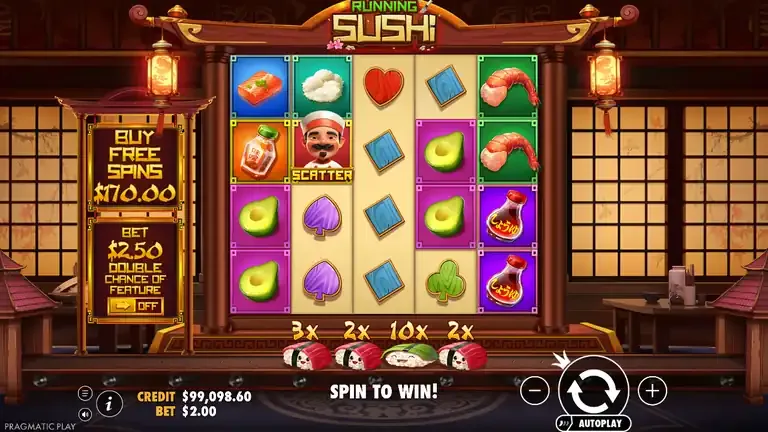
Landscape only, the build draws a wooden sushi bar behind paper screens, with the reels hung in the middle and the conveyor sliding beneath them. Every plate carries its price on a small tag, and the three collectors are drawn as people, a waitress for Take Sushi and a round cook for Take All. Three of them on one board pull the plates off the belt in a short animation. A Superb or a Congratulations banner then rolls over any win past a few tens of bets. During the free spins the room turns blue, the meter sits on the left under the words All the Sushi, and the counter under the reels keeps the round's running total. The intro carousel sells the belt with 1000x and 750x plates on it, prices the three logs never met. At turbo pace a paid spin took 3.6 seconds on average, rounds included, so the 2,768 spins filled two hours and forty-five minutes. No sound reached the log, which leaves me nothing to report on it. The game reads from across a room; the one number worth following is the meter on the left during the free spins.
What the ledger suggests
- A collection inside the round decides it, and neither collector carries a printed rate. Five rounds that landed three Take Sushi or three Take All paid 77.7 to 276.9 bets and six that landed neither paid 8.7 to 34. Take All itself came once in eleven rounds.
- The meter is wiped far more often than it is paid, and the sums are large. All eleven of our rounds closed with a sum on the counter, 4,539 bets in all, and across the pool the wiped meters held twenty-four times what Take All collected.
- The belt is a display first and a payout a distant second. It showed 25.6 bets a spin in our log and paid on one spin in 138, and the 300x plate it showed once was the largest in 5,938 pooled spins.
- Read the 90.32% as one warm log and two cold ones rather than as a verdict on the maths, which the rules put at 96.00%. The log that won a fifth of its stakes ran on the public demo at the same 2.00 stake as the two that lost.
- Every number on this page came out of a demo wallet, and demo credits fall under the same 18+ rule as money does.
Where to play it, and where the other logs live
Our sessions use the studio's public demo for one reason: its wallet can be read after every spin and the reading published, as the methodology page explains. The shelf copy here is that same public build, playing in the page from the address our log used. Each of the network's two dedicated Running Sushi sites publishes a log beside a playable build. runningsushislot.net carries Mia Stone's 1,623-spin session with eight rounds, the ledger pooled above. runningsushicasino.com carries Alex Reeves's 1,440-spin session, quoted above from the page. The figures taken from the first site are its ledger's, checked against the page when this review was written.
The belt runs in front of you on the Running Sushi demo page, which plays the provider's current public build inside the page. The other builds this portal has logged each keep a card on the Demo Shelf.
The rules page for Running Sushi restates the paytable at 2.00, the 26 plate values, both collectors, the cap and the buy price, each beside its screen.
Running Sushi FAQ
What is the RTP of Running Sushi?
Page four of the build's rules prints 96.00% three times over, once for normal play, once for the ante bet and once for the buy, and the studio's page for this game carries 96% as well. The setting a casino runs is its own choice, so read the rules of the copy you have open. This portal's log closed at 85.02% over 2,768 paid spins and the three-log pool at 90.32%, single afternoons both, not a rate.
How does the conveyor belt pay?
On its own the belt pays nothing at all, whatever it shows. Two to ten plates appear under the reels on every spin, each with a printed price from a list of 26 values between 1x and 1000x the base bet. Three Take Sushi symbols on the first, third and fifth reels collect them all at once. In our log it happened on 20 of 2,768 paid spins, for belts worth 9 to 58 bets. The largest belt of the log, 310 bets, passed with a single collector on the board.
How do the free spins start, and how often did they come?
Three scatters on the second, third and fourth reels open ten free spins, and the rules print no retrigger. Eleven rounds came in our 2,768 paid spins, one per 252, after waits of 36 to 583 spins. Across the pool's 5,938 spins there were 21 rounds, one per 283, and the rules print no rate for them.
What does the meter in the free spins do?
It banks the price of every plate that appears during the round, whether three Take Sushi paid that belt or not, and three Take All symbols on the middle reels pay the meter out and reset it. One Take All came in our eleven rounds, 434.00 inside the best round, while Take Sushi paid the belt eight times inside four rounds for 726.00. A meter that no Take All reaches is forfeited when the tenth spin settles, and all eleven of our rounds closed with a sum on it, 4,539 bets in all.
Can you buy the free spins, and what does the ante bet cost?
Yes to both, and both prices stand on the left panel in the current stake. The buy costs 85 times the base bet, 170.00 at our 2.00, and opens a round at once. An ante bet lifts the stake by a quarter and, in the rules' wording, doubles the chance of a natural trigger while the buy goes dark. Every one of the 21 pooled rounds came from scatters in ordinary play, with neither switch on.
Can I play Running Sushi for free?
Yes, with no account and no deposit, since the studio's public build is on our Demo Shelf on demo credits and its seven rules pages are behind the i button. A short sitting can pass without a round, since one per 252 is an average and not a promise, and demo credits carry the 18+ rule as money does.
My reading
Running Sushi is a ways game with a shop window under it, and the window is the review. I rate it 6.8, a tenth above Floating Dragon: Year of the Snake at 6.7 and two tenths above Big Bass Bonanza 1000, a tenth under Thunder Coins. The base game earns those tenths over its two relatives on this shelf. It paid on one spin in eight at two bets a median and returned 55.60% of the stakes on its own. It also let the belt pay twenty times in 2,768 spins, which no fish of the sister build ever did outside its feature. The return is printed three times, the cap is printed as a rule that ends a round, and both shortcuts carry their prices on the panel. Two deductions sit under the figure, and the headline comes first, sold on the belt itself. The intro carousel shows 1000x and 750x plates, the rules list 26 values and weight none of them, and no plate above 300x appeared in 5,938 pooled spins. The second is the meter, a counter that fills in full view, was paid out once in eleven rounds and wiped eleven times. A design that shows the player money and takes it back is a design choice, named as one, and the rules don't mention it. The label is a third and smaller matter, and it gets one sentence here. High in May and Low in October over the same printed return, cap and prices tells a player nothing about the game and something about labels. Nothing here is deducted for what the logs failed to meet, since an absence counted is still a count. No plate above 300x in 5,938 spins is one count, and eleven meters in eleven rounds wiped at the close is another. Again, this is a score in the high sixes, where the shelf's collectors sit, and the reason is the window rather than the ledger. An afternoon at 85.02% takes no points off and one at 122.34% adds none. What I liked most was a base game that collects; what I liked least was a meter that counts to 598 bets and then counts to nothing.
Corrections and updates
- No corrections yet. Substantive changes to figures or facts will be listed here with their dates.
Report an error: use the contact form and mention Running Sushi and Session ID RUSH-20260730-01.

Former studio-side game mathematician: paytables and RTP models, now checked from the player's side. Full profile and method →