
Running Sushi Rules: 1,024 Ways, the Conveyor, Two Collectors and the Printed Prices
Verdict first - a ways game with a shop window. Five reels, four rows, 1,024 ways, and under the reels a conveyor that carries two to ten plates with printed prices on every spin. Three Take Sushi symbols on reels 1, 3 and 5 collect the belt. Three scatters open ten free spins where the plates go into a meter and three Take All symbols pay it. The return is printed three times at 96.00%, the cap at 3,000x as a rule that ends a round, the buy at 85x. Everything below is read from the build's seven rules pages, with the portal log as the check.
Reference build, and the three things this one changes
The closest comparison in my log is Big Bass Bonanza 1000, tested on bigbassbonanzaplay.org. Both builds print money values on the screen and pay them only when a collector arrives. There the values sit on fish inside the reels and one wild collects them, free spins only. Here the values sit on plates under the reels, on every spin, and the collector is three symbols at once - three Take Sushi for the belt in both parts of the game, with three Take All added in the free spins to pay the meter. The board is wider, five reels by four rows on 1,024 ways instead of ten lines. The cap is lower, 3,000x against 20,000x. The retrigger ladder is gone - ten free spins, no badges, no multiplier. Everything below is read from the public demo's seven rules pages, with the portal log as the check.
Short system, short report. Pages one to four hold the whole machine. Pages five to seven describe the buttons.
How a spin pays
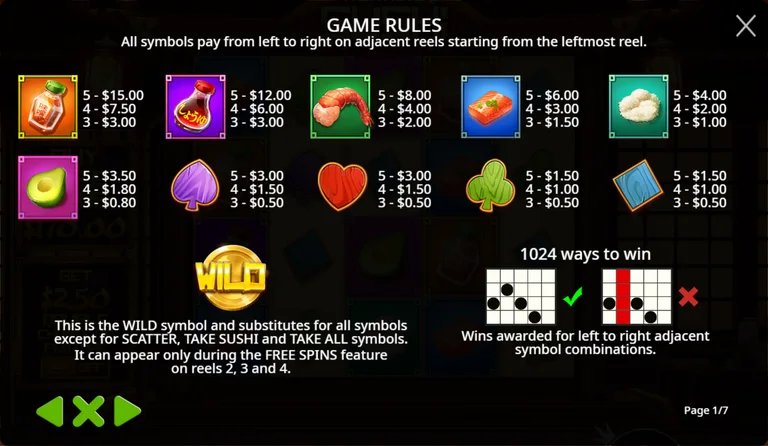
Ways, not lines. Every symbol pays left to right on adjacent reels, starting at the leftmost, with one win per combination on the same way and wins on several ways added up. Four rows on each of five reels make the 1,024. The paytable shows cash at the stake in play, and the screens were read at 2.00, the stake of all three logged sessions, so each figure below is a sum and a multiple at once.
| Symbol | Five / four / three at 2.00 | Five in multiples | Three in multiples |
|---|---|---|---|
| Hot sauce jar | 15.00 / 7.50 / 3.00 | 7.5x | 1.5x |
| Soy sauce bottle | 12.00 / 6.00 / 3.00 | 6x | 1.5x |
| Shrimp | 8.00 / 4.00 / 2.00 | 4x | 1x |
| Salmon roll | 6.00 / 3.00 / 1.50 | 3x | 0.75x |
| Rice ball | 4.00 / 2.00 / 1.00 | 2x | 0.5x |
| Avocado | 3.50 / 1.80 / 0.80 | 1.75x | 0.4x |
| Purple spade, red heart | 3.00 / 1.50 / 0.50 | 1.5x | 0.25x |
| Green clover, blue diamond | 1.50 / 1.00 / 0.50 | 0.75x | 0.25x |
Three of a kind returns less than the stake on seven of the ten symbols and exactly the stake on the shrimp. A single way of five hot sauce jars returns seven and a half stakes, and the same symbol on several ways multiplies that. The wild, the scatter, Take Sushi and Take All carry no pay of their own. Checked against the log, the last paid spin of the portal session landed four hearts on twelve ways and paid 18.00, twelve times the 1.50 in the table. The paytable holds.
The conveyor, and the three symbols that empty it
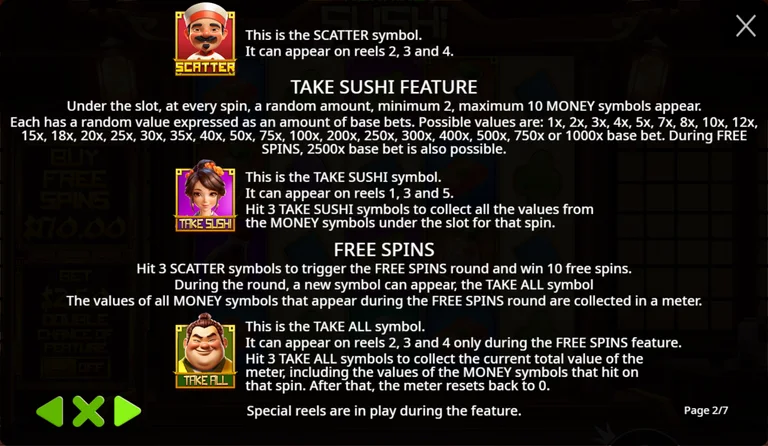
Under the reels, on every spin, between two and ten money symbols appear. The screen calls them MONEY symbols and draws them as plates on a belt. Each carries a random value expressed in base bets, and the page prints the list in full, 1x, 2x, 3x, 4x, 5x, 7x, 8x, 10x, 12x, 15x, 18x, 20x, 25x, 30x, 35x, 40x, 50x, 75x, 100x, 200x, 250x, 300x, 400x, 500x, 750x or 1000x. During the free spins 2500x is also possible. No weight is printed for any of them. A plate on the belt is a picture of money until a collector lands.
In the base game the collector is the Take Sushi symbol, which appears on reels 1, 3 and 5. Three of them collect all the values from the money symbols under the slot for that spin. Two of them collect nothing. The belt then refreshes with the next spin whether it was collected or not. One collection per 138 paid spins is what the portal log counted, 20 in its 2,768, with belts worth 9 to 58 bets at the moment they were taken. Its largest belt carried 310 bets on the 2,285th spin, a 300x plate among three, and one Take Sushi stood on the board. Not collected. Across 5,938 pooled spins no plate above 300x appeared on any belt, in the base game or the free spins, and 400x, 500x, 750x, 1000x and 2500x stayed on the rules page.
Free spins, the meter and Take All
Three scatters trigger the free spins round, ten spins. The scatter appears on reels 2, 3 and 4 only, so three is the most a board can hold and the page prints no award for more. During the round a new symbol can appear, Take All, on reels 2, 3 and 4 and in the feature only, while Take Sushi keeps working on reels 1, 3 and 5. The values of all money symbols that appear during the round are collected in a meter. Three Take All symbols collect the current total of the meter, including the values of the money symbols that hit on that spin, and the meter then resets to zero. Three Take Sushi inside the round pay the belt of that spin as in the base game, and the log shows the meter keeping those plates as well. The wild also exists only here, on reels 2, 3 and 4, and substitutes for everything except the scatter, Take Sushi and Take All. The page adds one line, special reels in play during the feature, with no detail behind it. No retrigger is printed, and none happened in 21 logged rounds.
What the text does not say is what happens to a meter nobody collects. The log answers that - it is forfeited when the tenth spin settles. Five of the eleven portal rounds landed a collector at least once, four of them Take Sushi only and one Take All, and those five paid between 77.7 and 276.9 bets. The other six paid between 8.7 and 34 bets on ways wins alone. All eleven closed with a sum on the meter, 9,078.00 together. The best round, opened on the 238th paid spin, collected 434.00 on its fifth free spin with 350.00 already on the meter, then paid 553.80 in all. Hit three Take All early and the meter is small. Hit them late and the meter is large. Never hit them and the meter was a number on the left of the screen.
Max win, ante bet and the buy price
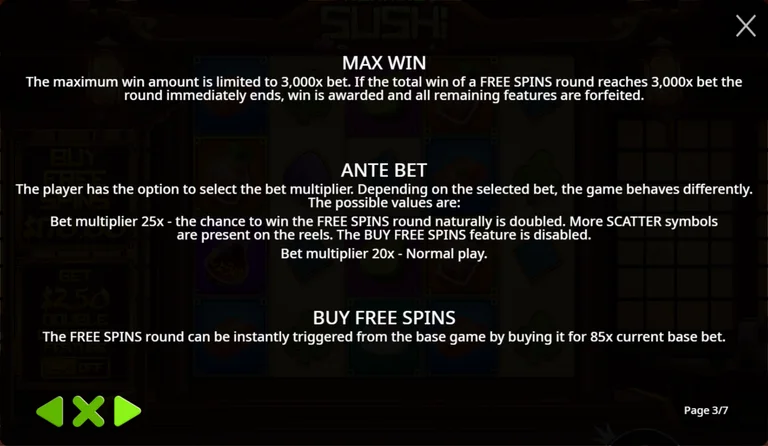
Max win first. The maximum win amount, in the page's words, is limited to 3,000x bet, and a free spins round that reaches it stops at once with the win awarded and all remaining features forfeited. Page six repeats the figure as 3000X with the same rule - a cap, not a prize. The game's own settings carry a second figure for the ante stake, 2,400x of that larger bet, which is the same sum of money.
Ante bet next. The rules put it as a choice of bet multiplier - 25x doubles the chance of a natural free spins round, puts more scatters on the reels and disables the buy, while 20x is normal play. The screen shows it as a toggle labelled DOUBLE CHANCE OF FEATURE, a quarter above the stake - 2.50 against 2.00, 12.50 against 10.00.
Buy. Pay 85x the current base bet to trigger the free spins round from the base game. At 2.00 the button reads 170.00, and at 10.00 it reads 850.00. The number of scatters on the bought spin and the size of the meter at its start are not printed. Neither the button nor the toggle was used in any of the three logged sessions.
What page four prints
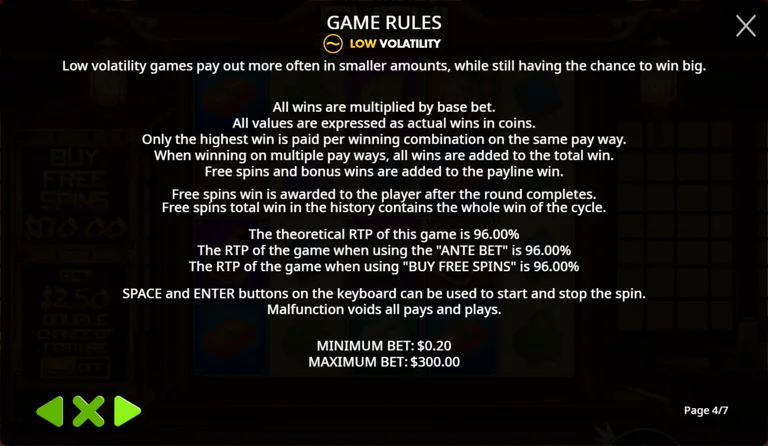
Volatility - a LOW VOLATILITY label, with the sentence that low volatility games pay out more often in smaller amounts, while still having the chance to win big. The same pill sits on the intro screen. The copy archived on 25 May 2026 carried five lightning bolts and a high volatility sentence in that spot. Same game, same 96.00% and the same cap under a different label. Three return lines follow, 96.00% for the game, 96.00% with the ante bet and 96.00% with the bought round. Bet limits 0.20 and 300.00. The small print says wins multiply by base bet, values show as actual wins in coins, one win per combination on the same way, and the free spins total is paid once the round completes. The usual malfunction clause closes the page, with a note that the space and enter keys run the spin. The first response of the game to our session on 30 July 2026 carried the same three return figures, the same 3,000x limit and the same buy price as the demo read on 12 October 2026.
What the screens do not price
No odds for any of the 26 plate values, and none for the 2500x in the free spins. No rate for three Take Sushi, none for three Take All, none for the scatters. No rule for a meter left uncollected, though the log settles that one. No retrigger. No detail behind the special reels of the feature. No pay for the wild, the scatter or either collector. No release date, no version number. Printed, by contrast, are the return three times over, the cap on pages three and six, and the bet limits on page four. I log what the build pays and publish that instead: 85.02% on the portal's paid spins and 90.32% over the pooled spins, tables in the review. Neither is a long-run rate, and the 6.8 in the review grades the machine rather than the sitting.
Quick answers
Do the plates on the belt pay by themselves?
No. Three Take Sushi collect the belt in both parts of the game, three Take All collect the meter in the free spins. Two collectors collect nothing.
Does the meter carry over to the next round?
No. Whatever is on it when the tenth free spin settles is gone. All eleven portal rounds closed that way.
Can the free spins retrigger?
Not by the text. Three scatters open ten spins and the page prints nothing more. None of the 21 logged rounds added a spin.
Does the ante bet change the paytable?
No. Same symbols, same prices, a stake a quarter higher. More scatters on the reels, and the buy button goes dark.
Is the 3,000x a prize?
No. A cap. The round stops there and the rest of its features are forfeited.
All seven pages sit behind the i button of the provider's public demo on our shelf - read them on demo credits first, then decide about money.
Known limits of this page
Known limits of this page: a dollar demo read on 12 October 2026 at 2.00, and screens archived on 25 May 2026 for comparison. Plate weights, not printed and not verified. Collector rates, the same. The ante mode and the bought round, unused in all three logged sessions. No version line is printed in the build, so the shelf demo is the public address we logged and not a build we can prove identical, and its volatility label did change between May and October while the return and the cap stood. Everything else here was read off a screen or out of the portal log.
Verified against
Session RUSH-20260730-01 - 2,768 spins of the 5,938-spin pool, July 2026, checkpoint discipline throughout. The session tables, screenshots and the score live in the Running Sushi review. The launch build is on the demo shelf, and the protocol is on the methodology page. What this page did not verify - plate weights, collector rates and the meter of a bought round. Balances before and after each of the eleven rounds, and the meter each one left behind, sit in the session report. Rules read from the public demo on 12 October 2026. 18+ in demo play as in any other.

Casino analyst with a software QA background: every game is a system under acceptance test. Full profile →