
Fortune Tiger Review: One Symbol Drawn, Nine Cells to Fill
Fortune Tiger is a three-by-three PG Soft slot with five fixed lines and one feature. A random respin rebuilds the reels around a single drawn symbol and holds every match until a stop adds nothing new. Any full screen multiplies the win by ten, inside the feature or out of it. The session ran 2,825 paid demo spins at 3.00 and came back at 118.44% on its stakes, with the feature firing 28 times, once per 101 spins. The tenfold landed 28 times as well, sixteen of them on ordinary spins. The build prints the paytable, the rule and the 2,500x route, and leaves the return and the trigger rate to the studio's sheet.
- Who it suits: players who want a small grid they can read at a glance, a respin they can watch fill, and a base game that pays one line at a time between the full screens
- Core mechanic: a random respin that rebuilds the reels around one drawn symbol and holds every match, with any full screen paid ten times over, in the feature or in the base game
- Key risk: the build prints neither its 96.81% return nor a trigger rate, both sit on the studio's sheet, where the 0.99% feature row goes undefined and one spin in 101 is our reading of it, and the 2,500x needs nine wilds on one screen
- Rating: 7.0/10
Game Information
128.37% tested, pooled on paid spins
462x tested, best single spin (all sessions)
Where the stated figures come from
| Figure | Value | Source | Checked | In the tested build |
|---|---|---|---|---|
| Stated RTP | 96.81% | PG Soft game card and Game Information sheet (PDF, version 1.0 r5, updated 8 July 2025): 64.96% base game plus 31.85% feature (sheet (PDF)) | sheet read 21 September 2026 | No: the nine paytable and rules screens price every symbol and never mention RTP |
| Advertised max win | 2,500x | Loading screen ('win up to 2500x') and the in-game paytable (nine wilds on five lines, times ten); the Game Information sheet lists the same 2,500x as its billion-spin maximum | build as logged on 4 August 2026 | Yes: loading screen and paytable |
| Volatility | Medium | PG Soft Game Information sheet, session volatility: engaging (medium) (sheet (PDF)) | sheet read 21 September 2026 | Not read from the build for this review |
| Bonus trigger | Random, on any spin: respins around one drawn symbol until nothing new lands | In-game rules, restated value by value on our rules page (rules page) | build as logged on 4 August 2026 | Yes: printed in the rules |
| Feature frequency | 0.99% | PG Soft Game Information sheet, frequency table: a row the sheet does not define; one spin in 101 is our reading of it (sheet (PDF)) | sheet read 21 September 2026 | No: the build prints no trigger rate |
Where a figure is our reading of a source, the row says so. Live RTP is the operator's choice: check the info screen where you play.
Two promises on the loading screen
Fortune Tiger opens on a splash that makes two claims, respins and a tenfold multiplier, and a third line that says win up to 2,500x. The machine behind the splash is as small as a slot gets. Three reels, three rows, five fixed lines, six paying symbols and a tiger wild that stands in for all of them. A line pays three of a kind from the left, the highest win per line only, and lines that pay together are added. There is no scatter, no free spins round, no buy button and no meter of any kind; everything else is a fruit machine with a mascot. The respin is the feature, the tenfold is the condition attached to a full screen, and the 2,500x is what the two produce together at the top of the paytable.
Our log of 2,825 paid spins at 3.00 is the test of both promises, and this review is organised around them. How often did the respin come, what did it pay, and how often did nine positions light at once. The short version is that both promises were kept on the studio's own terms. The feature fired 28 times, once per 101 paid spins, and the studio's 0.99% row says the same on our reading of it. The tenfold landed 28 times as well, sixteen of them on ordinary spins with no feature in sight. What the splash doesn't say is what any of that returns over the long run. The build doesn't say either, and that silence is the one deduction this page carries.
The respin, held symbol by held symbol
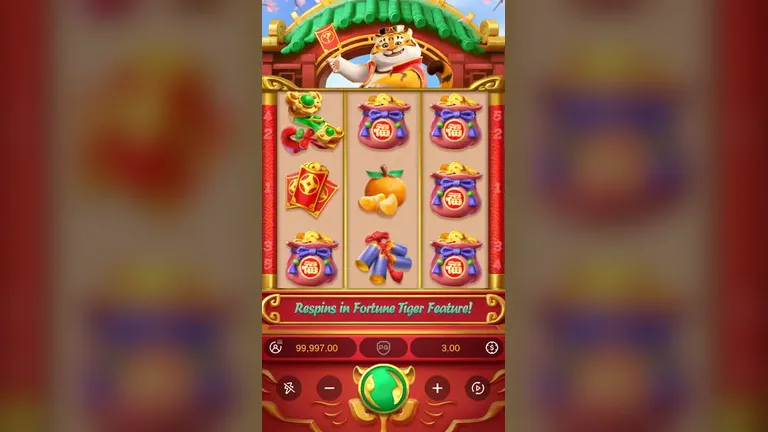
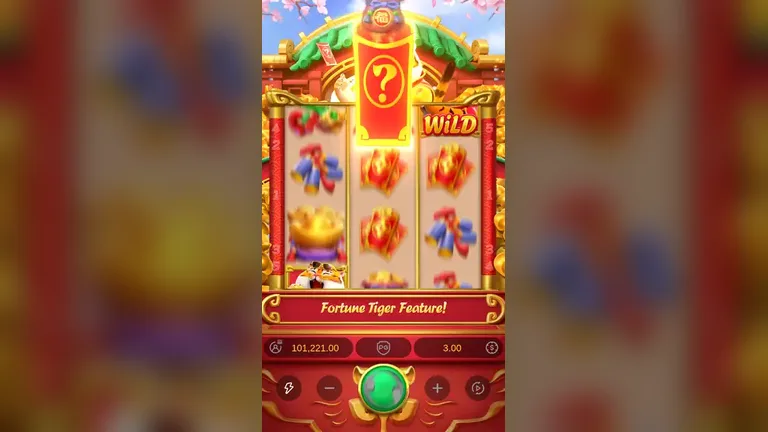
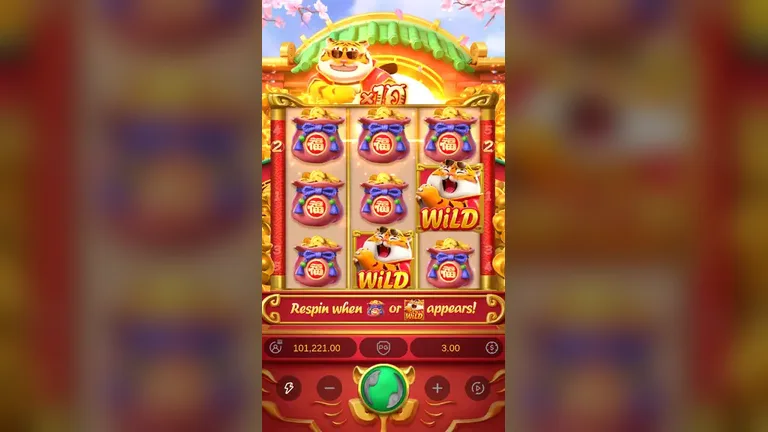
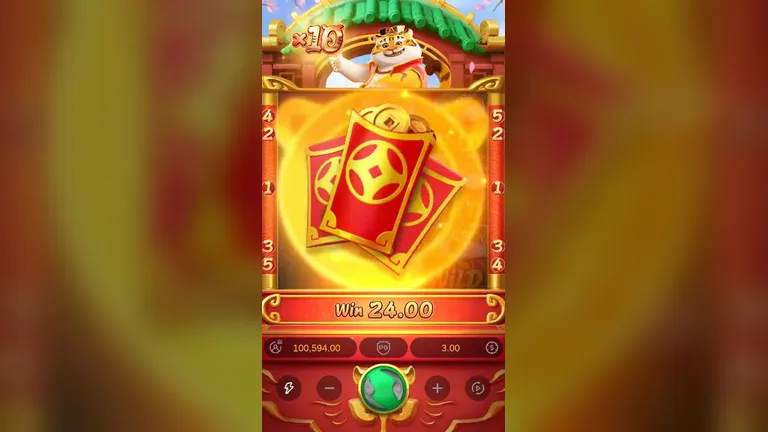
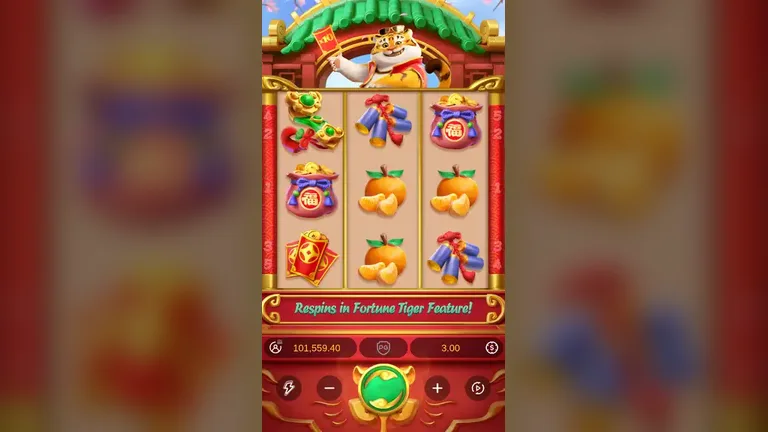
The feature announces itself while the reels are still turning, before anything has landed. A red scroll unrolls above the grid with a question mark on it, and the tiger draws one of the six paying symbols. The reels are then rebuilt around that symbol alone, so that it can land, the wild can land, and everything else is blank. Whatever lands is held, the reels spin again, and they keep spinning for as long as each stop adds at least one new match or wild. The first stop that adds nothing ends the round, the lines are read and paid, and a full screen at that point is multiplied by ten. The stake is taken once, on the triggering spin, and the respins themselves cost nothing. The wallet in our log moved by exactly the round's total each time.
Twenty-eight rounds arrived in 2,825 paid spins, which is one per 101. A count of 28 pins the true rate only loosely, and an exact Poisson interval at 95% leaves the round anywhere between every 70th paid spin and every 152nd. The sheet's 0.99% row for the feature is the same figure to the nearest spin, on my reading of a row the sheet does not define. Three rounds ended after a single respin, sixteen took two, eight took three and one took four. The gaps between rounds ran from a single spin, two rounds arriving back to back, to a silence of 496 spins, a sixth of the whole log. Whereas the clock kept to the sheet across the run, the payouts did not spread themselves out to match. Each figure below is the wallet's change from the triggering stake to the settlement, and all 28 reconcile against the ledger to the cent.
| Round | Trigger spin | Respins | Round payout | Payout ×bet | Full screen |
|---|---|---|---|---|---|
| 1 | 12 | 2 | 150.00 | 50.0x | yes |
| 2 | 76 | 2 | 9.60 | 3.2x | no |
| 3 | 89 | 2 | 5.40 | 1.8x | no |
| 4 | 161 | 2 | 5.40 | 1.8x | no |
| 5 | 252 | 2 | 18.00 | 6.0x | no |
| 6 | 334 | 1 | 15.00 | 5.0x | no |
| 7 | 338 | 3 | 5.40 | 1.8x | no |
| 8 | 834 | 2 | 5.40 | 1.8x | no |
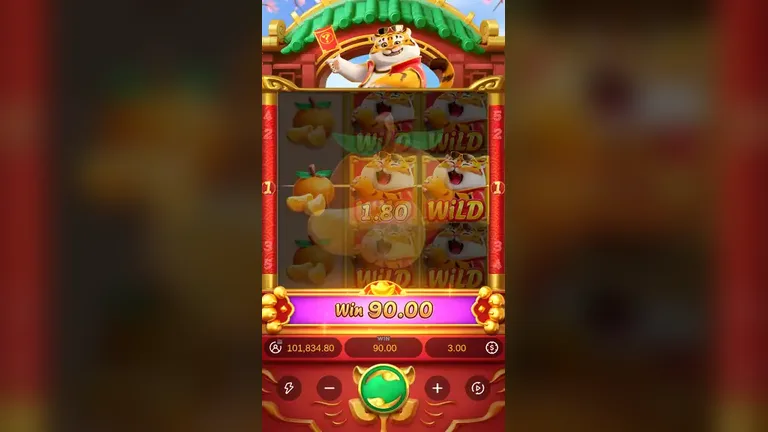
| 9 | 840 | 3 | 90.00 | 30.0x | yes |
| 10 | 884 | 1 | 90.00 | 30.0x | yes |
| 11 | 893 | 3 | 90.00 | 30.0x | yes |
| 12 | 1,046 | 3 | 7.20 | 2.4x | no |
| 13 | 1,085 | 3 | 7.20 | 2.4x | no |
| 14 | 1,478 | 2 | 7.20 | 2.4x | no |
| 15 | 1,515 | 2 | 90.00 | 30.0x | yes |
| 16 | 1,658 | 2 | 90.00 | 30.0x | yes |
| 17 | 1,669 | 3 | 24.00 | 8.0x | no |
| 18 | 1,689 | 2 | 60.00 | 20.0x | no |
| 19 | 1,938 | 2 | 90.00 | 30.0x | yes |
| 20 | 2,115 | 2 | 19.20 | 6.4x | no |
| 21 | 2,202 | 2 | 5.40 | 1.8x | no |
| 22 | 2,215 | 3 | 240.00 | 80.0x | yes |
| 23 | 2,216 | 2 | 5.40 | 1.8x | no |
| 24 | 2,360 | 1 | 300.00 | 100.0x | yes |
| 25 | 2,448 | 4 | 300.00 | 100.0x | yes |
| 26 | 2,465 | 2 | 150.00 | 50.0x | yes |
| 27 | 2,811 | 2 | 150.00 | 50.0x | yes |
| 28 | 2,815 | 3 | 9.00 | 3.0x | no |
| 28 rounds | one per 101 paid spins | 63 | 2,038.80 | 24.3x average | 12 of 28 |
Trigger spin counts paid spins only, respins excluded, which is how the two sister logs count theirs. Full screen means all nine positions sat in winning lines and the tenfold was applied. The twelve were checked against the on-screen totals and the x10 badge, and the remaining sixteen were read from the line arithmetic. Half the rounds paid 21.60 or less, which is 7.2 bets, against a mean of 72.81.
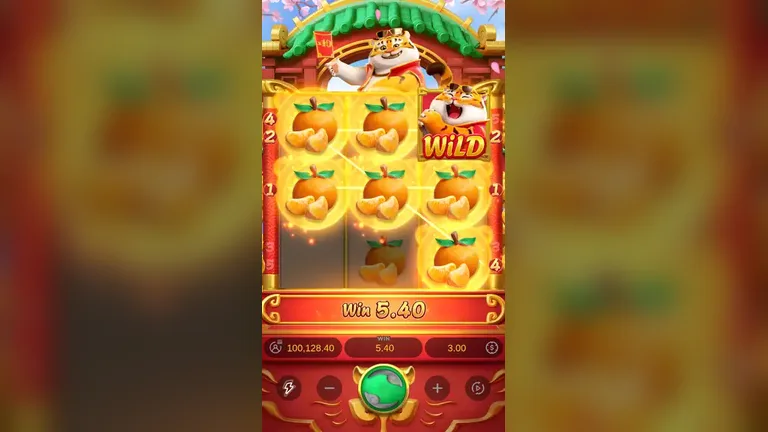
The table splits cleanly in two, and the first half is the sixteen rounds that stopped short of a full screen and paid what a partial fill pays. Six of them were three lines of oranges at 1.80 each, three were four lines of oranges, and the rest were a few lines of firecrackers, envelopes or bags. One round held a single jade knot line and one held a single ingot line, 60.00 and the best of the sixteen. Eleven of the 28 rounds paid under 10.00 at a 3.00 stake. The other twelve filled the grid and took the tenfold, and there the symbol on the scroll decided everything. Oranges filled it six times at 90.00, firecrackers three times at 150.00, envelopes once at 240.00 and bags twice at 300.00. Nothing above a bag was ever drawn into a full screen, and the two bag fills, 100 bets each, are the largest events of the whole log. A round on this machine is a lottery in two stages, the draw first and the fill second, and the draw does more of the pricing.
The tenfold, with and without the feature
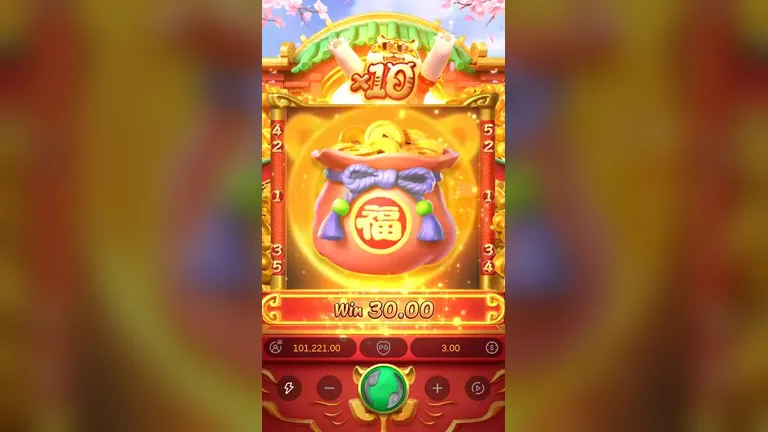
The x10 rule is a single sentence in the paytable, and nothing in it mentions the feature. When all symbols on the reels are involved in a win, the win is multiplied by ten, whichever spin produced it. A full screen in the base game qualifies just the same, and our log has sixteen of them in 2,797 base-game spins, one per 175. A sample that thin leaves the true rate between every 108th base spin and every 306th, on the same 95% interval. The largest base-game spin in the log paid 240.00, a column of envelopes beside six wilds. The same picture repeated itself seven hundred spins later, for the same 240.00. Four other fills mixed two or three symbols around a handful of wilds, so that each line paid as its own symbol and the tenfold sat on the sum. Between the feature's twelve and the base game's sixteen, the tenfold landed 28 times in the session, one spin in 101, which is the feature's own clock to the spin. Those 28 spins paid 4,260.00 between them, a little over two fifths of everything the session returned.
| Symbol drawn or filled | One line at 3.00 | Full screen, times ten | In bets | Seen in our log |
|---|---|---|---|---|
| Orange | 1.80 | 90.00 | 30x | 10 times, four in the base game |
| Firecrackers | 3.00 | 150.00 | 50x | 9 times, six in the base game |
| Red envelopes | 4.80 | 240.00 | 80x | 3 times, two in the base game |
| Money bag | 6.00 | 300.00 | 100x | Twice, both in the feature |
| Jade knot | 15.00 | 750.00 | 250x | Not once in 28 full screens |
| Gold ingot | 60.00 | 3,000.00 | 1,000x | Not once in 28 full screens |
| Wild, all nine | 150.00 | 7,500.00 | 2,500x | Not once in 28 full screens |
| Mixed fill, wilds between two or three symbols | each line as its symbol | 96.00 to 216.00 in our log | 32x to 72x | 4 times, all in the base game |
Line values are the printed coefficients times 0.60, the bet size times bet level behind a 3.00 stake on five lines. A full screen pays all five lines and then ten times that sum. A screen that mixes wilds into a symbol pays the same as a screen of that symbol, unless a whole line is wild, which pays the wild's 150.00 instead. Two spins of the log paid a wild line without filling the grid, 150.00 on its own and 165.00 with a knot line beside it. The four mixed fills paid 96.00, 168.00, 210.00 and 216.00, each the sum of five lines of two or three symbols, times ten.
The upper half of that table is where the splash's 2,500x lives, and the route to it is printed in full: nine wilds, five lines at 150.00, times ten. The sheet's billion-spin simulation stops at that same 2,500x, so the figure is a real edge of the paytable, and no rule cuts a spin short of it. What isn't printed anywhere, in the build or on the sheet, is the weight of a knot, an ingot or a wild against an orange when the scroll unrolls. Twenty-eight full screens of the four cheapest symbols and none of the three dearest is a count of outcomes, not a reading of the draw. Only twelve of them followed a draw at all, and each of those mixes the symbol drawn with the fill that came after. I would expect the weights to fall steeply, because a game that filled the grid with ingots at any working frequency would have no return left to sell. The sample is consistent with that expectation, and 28 fills prove nothing either way.
The base game between the fills
Take the 28 rounds out and 2,797 paid spins remain, and they carried most of the session on their own. Base-game wins came to 7,998.60 across those spins, against 2,038.80 from the 28 rounds of the feature. The respin delivered a fifth of the return where the sheet's split would have it deliver a third, which is one warm session's shape and nothing more. The base game paid something on 713 of those 2,797 spins, which is 25.49% against the sheet's 22.16% main-game row. With the 28 rounds counted as well it becomes 741 paying spins in 2,825, or 26.23%, against the sheet's 23.15% top line. The longest run without a return lasted 19 spins, among the shortest flat stretches on this shelf, where the fifteen earlier logs run from 15 spins to 78. The wallet never fell more than 94.20 under its opening figure at any point in the run. Its worst slide from a high was 501.00, or 167 bets, spread over 317 spins, and the balance needed another 250 spins to climb back to where it had been.
What the 713 paying spins returned decides whether the base game is company or filler. Of those 713, 211 were a single line of oranges paying 1.80, less than the stake. Another 290 returned between one and two bets, which is one line of firecrackers or envelopes, or two or three orange lines together. Spins that gave back at least the stake numbered 502 of the 2,797 base spins, and 530 of all 2,825 paid once the rounds are counted, 18.76%. Fifty paid between five and twenty bets, 45 of them one line of jade knots. Another 37 paid between twenty and fifty, most of them an ingot line with or without small change beside it, and five of them full screens. Thirteen paid fifty bets or more, eleven of those full screens with the tenfold on them and two a line of three wilds. The median paying spin returned 3.60, so a typical win on this machine is one small line, and the balance moves in slow steps until a screen fills. I prefer a base game that pays smaller and oftener to one that pays nothing for a hundred spins, and I name that as a preference. The log shows the shape of the base game and doesn't grade it.
Three sessions, one of them counting the rounds
Three Fortune Tiger ledgers sit with the SlotLab testing team. This portal's runs under Session ID FTGR-20260804-01; the other two were logged in July on the network's dedicated Fortune Tiger sites, both at a flat 3.00 and both closing ahead. All three count paid spins only, with the respins left out as the game itself leaves them out of the stake, so the pool is plain arithmetic. The three add up to 22,628.60 back on 17,628.00 put down, 5,876 paid spins and a combined 128.37%. The biggest single spin across the three logs, 462 bets, sits in the fortunetigerslots.org session, a full screen with the tenfold on it. It beat anything in our log by a wide margin, and it beat the sheet's Super Mega Win threshold nine times over. Neither sister log counted its feature rounds, because the respin fires inside an ordinary spin and leaves no separate event to tally. The 28 rounds and the one-per-101 clock above are therefore this portal's alone.
| Source | Spins | Observed return | Feature rounds | Best single spin | Net result |
|---|---|---|---|---|---|
| CasinoReview.click | 2,825 paid | 118.44% | 28, one per 101 | 100x, full screen | +1,562.40 |
| fortunetigercasino.org | 1,524 | 138% | not counted | 82x | +1,762.80 |
| fortunetigerslots.org | 1,527 | 136.6% | not counted | 462x, full screen | +1,675.20 |
| Combined | 5,876 paid | 128.37% | 28 counted, one log | 462x, single spin | +5,000.40 |
Our own line is 8,475.00 of paid stakes against 10,037.40 returned. The sister lines carry the figures their pages publish, and fortunetigercasino.org publishes 138% where its own ledger closed at 138.56%. Its 6,334.80 of returns in the Combined row is its 4,572.00 of stakes plus the 1,762.80 its balance gained across the run. The Combined row is the sum of the three returns over the sum of the three stakes.
CasinoReview.click Erik Lindholm's log · August 2026
fortunetigercasino.org Alex Reeves's log · July 2026
fortunetigerslots.org Mia Stone's log · July 2026
Three logs that all closed between 118% and 139% describe a warm summer and not a maths model. The three hit frequencies, 25%, 25.1% and 26.23%, are the only figures on which the three agree closely. The sister sessions also report their flat stretches, 23 and 20 spins without a return against our 19, on a shelf whose stretches run from 15 spins to 78. One log with a 462x screen and two without says what a single full screen can do to a session of fifteen hundred spins. The two logs that did not count their rounds could not price the clock, and ours could. The clock on this page therefore carries one sample and the return carries three.
FTGR-20260804-01 · Evidence retained: 9,714 timestamped frames plus the full session log. Read the session report: FTGR-20260804-01. Frames beyond its tables are available on request through the contact form.
The return, on the sheet and not on the screen
The build prices every symbol, describes the feature twice and states the 2,500x as a working figure. In an archive of 51 screens from the build, nine of them paytable and rules pages, there is no return line and no trigger rate, and both live on the studio's side. PG Soft's Game Information sheet (version 1.0 r5, dated 8 July 2025) gives 96.81% as the theoretical return and divides it as 64.96% for the base game and 31.85% for the feature. Its frequency table has a 0.99% row for the feature, and the rows add up, 22.16% for the main game plus 0.99% for the feature equals its 23.15% top line. The feature row therefore reads, to me, as the share of spins on which the feature fires, one in 101, and the log agreed with that reading to the spin. The studio's site carries the same 96.81% on the game's card, beside the maximum and the volatility. It's the arrangement PG Soft runs on every game of its on this shelf, and it earns the same mark here as it did on the other three. The number a player most needs is the one the player can't reach from the chair.
Our session's figure is 118.44% on paid stakes, and the three-session pool's 128.37%. Neither is the long-run rate of the game; both are warm draws from a distribution the sheet describes and the build keeps to itself. The log behind our figure also needs a sentence of its own. The session record treated every reply from the game as a stake, and the respins reply without one. The raw ledger therefore reads 8,664.00 staked and 10,226.40 returned, a 118.03% ratio built on 63 stakes that were never taken. The wallet, read after every spin, never lost more than 3.00 at a time, and the figures on this page are the wallet's. The configuration that binds is the one a casino licensed, readable only on the info screen of that copy, where a copy prints it.
Editor's note: reading the RTP numbers. Stated RTP for this title comes from PG Soft's own site, where the game's card lists 96.81% and the Game Information sheet, a PDF, gives the breakdown; the tested demo build prints no return line in its rules, so neither confirms the RTP configuration of the build we logged. Our tested figure is the pooled return of the three logged demo sessions behind this review, calculated by money as total returns over total stakes on paid spins, 22,628.60 over 17,628.00, and the CasinoReview session alone returned 118.44% on its paid stakes. Our ledger also recorded each respin of the feature as if it carried a stake, which reads 118.03% before those 63 entries are set aside; the sister logs count paid spins only. Even a pooled sample of a few thousand spins is not the game's long-run maths. Live RTP is an operator choice: many games ship in several RTP configurations and the casino picks which one to run, so always check the RTP in the game's info screen before you bet real money. More in our guide to stated vs observed RTP.
Fortune Rabbit, the studio's other small grid on this shelf
The nearest comparison here is Fortune Rabbit, the same studio's ten-position grid with a count of five prize tiles for a feature and the same silence on the return. The two games spend their randomness at different moments, and that timing is the whole of the comparison. Fortune Rabbit decides everything at the count, since five tiles pay their sum and four pay nothing, and its eight fortune spins are that rule repeated. Fortune Tiger decides most of it at the draw, before a single held symbol has landed, and then lets you watch the fill. Its clock ran once per 101 paid spins against Fortune Rabbit's once per 175, and its base game paid on 25.49% of base spins against 22.37%. Its rounds paid less when they paid, a median of 7.2 bets against 32.5. Fortune Rabbit pays its rounds as sums of printed tiles, and Fortune Tiger as line wins multiplied. The largest events were 100 bets here, from a screen of bags, and 127 there, from a screen of plaques. Both builds print the mechanism and neither prints the return, and both reviews carry the same mark for it. The respin is a process you watch, held symbol by held symbol, whereas the count is a verdict read off a finished board. The process is the more legible of the two, and legibility weighs in the rubric.
What it looks like from the chair
The build runs in portrait and fills a phone the way it was drawn to. The tiger sits in the arch above the reels in sunglasses and a red vest, and he moves on every event worth noticing. The scroll unrolls from his paws and the drawn symbol flashes on it. A full screen brings a golden flare with the x10 badge lit at the top of the frame, and a Big Win or Super Mega Win counter then climbs over the reels while the wallet waits. Held symbols glow gold during a respin, so a fill is readable at a glance from the other side of a room. At autoplay pace a spin settled in four seconds and a round in a dozen, a tempo that suited a long log and would suit a phone on a train. The mascot's charm wears thin by the third hour, which is a fault of the third hour rather than the drawing. As a piece of drawing it is bright, quick and legible, and legibility is the part that matters to a review.
What the ledger suggests
- The base game carried this session, and the feature did not. Four fifths of the return arrived outside the rounds, mostly as one small line at a time, and sixteen of the 28 full screens needed no feature at all. The money in this log came from there, and the next log owes that split to nobody.
- In this sample the median round paid 7.2 bets. Eleven of the 28 paid under 10.00 at a 3.00 stake, and the two that paid 100 bets were the two that drew a bag and filled the grid. The symbol on the scroll set the scale of the round before the fill began.
- Read the 128.37% as three warm afternoons. The pool is honest arithmetic on real stake and return totals and still a sample. The sheet says 96.81%, and a fourth session owes nobody a fourth profit.
- The 18+ rule holds for free play as it holds for money, and every figure here was logged on demo credits.
The demo, the rules page and the two other logs
Every session on this portal runs on the provider's public demo, because a demo wallet leaves a ledger that can be read back reading by reading and published, under the protocol on our methodology page. The Fortune Tiger build plays in the page on our shelf, launched from the same public demo link our log ran on. Two more Fortune Tiger logs are published on the network's dedicated sites, and each site carries a playable build. The 1,524-spin session with the 82x peak is Alex Reeves's, at fortunetigercasino.org. The 1,527-spin session that holds the 462x screen is Mia Stone's, at fortunetigerslots.org. Both sets of figures are taken from those pages as they read on the day this review was written.
The scroll unrolls in front of you on the Fortune Tiger demo page, on the provider's current public demo, and the rest of our tested builds sit one card away on the Demo Shelf.
The line paytable at 3.00, the full-screen table and the bet formula are restated on the Fortune Tiger rules page, beside the screens they came from.
Fortune Tiger FAQ
What is the RTP of Fortune Tiger?
No return figure appears on any rules or paytable screen of the tested build. PG Soft's site shows 96.81% on the game's card, and its sheet, a downloadable PDF, splits it as 64.96% base game and 31.85% feature. Which configuration a casino runs is its own business, so read the info screen of your copy. Our session came back at 118.44% over 2,825 paid spins, the pooled figure is 128.37%, and neither number is the game's long-run rate.
How does the Fortune Tiger Feature trigger?
At random, with no scatter and no meter, on any spin and while the reels are still in motion. The game draws one of the six paying symbols and rebuilds the reels from that symbol, wilds and blanks. It holds every match that lands and respins until a stop adds nothing new. The build prints no trigger rate, and the studio's sheet puts the feature at 0.99% in a table of frequencies it never defines, so we take that row to mean one spin in 101. Our log recorded 28 rounds in 2,825 paid spins, one per 101.
What does the x10 multiplier need?
All nine positions in winning lines at once, which usually means a full screen of one symbol with wilds standing in. Four spins in our log qualified on screens that mixed two or three symbols instead, so the condition is the win and not the sameness. The rule applies to any spin, feature or not, and our log has sixteen full screens on ordinary spins and twelve inside rounds. A full screen of oranges paid 90.00 at a 3.00 stake and a screen of bags 300.00. Every one of the 28 was made of the four cheapest symbols, alone or mixed with wilds and with each other.
How do you win 2,500x on Fortune Tiger?
With nine wilds on the grid at once, and the arithmetic is printed in the paytable. Five lines at the wild's coefficient of 250, multiplied by ten, come to 2,500 times the stake, and the sheet's billion-spin simulation gives that same figure as its largest outcome. No screen of wilds, ingots or knots appeared in our 28 full screens. The largest outcome in the three logged sessions was a 462x screen on a sister site's log.
Is there a bonus buy or a free spins round?
Neither: the respin feature is the only feature, it can't be bought, and it ends on its own when a stop adds nothing. There is no scatter symbol and no free spins round anywhere in the rules, and all 28 rounds in our log came unbidden.
Can I play Fortune Tiger for free?
Yes: the PG Soft public build plays on demo credits in the page on our Demo Shelf, with its rules screens one tap from the reels. Fifty spins will teach you the pace of the lines, and with any luck one scroll will unroll. Age limits apply to free play as they apply to money, 18+.
My reading
Fortune Tiger keeps both promises on its loading screen, and it keeps them in plain sight. The respin arrived once per 101 paid spins, which is the studio's own 0.99% row as we read it. The tenfold landed 28 times in 2,825 spins, most of them worth thirty to fifty bets. I rate it 7.0, level with Little Farm, above Fortune Rabbit and a step below Speed Winner, and the deduction is for disclosure. The build prints the paytable, the rule and the cap, and leaves the return and the trigger rate to a sheet on the studio's site. Nothing here is charged for what the log didn't see, which the rubric forbids in any case. No knot, ingot or wild screen in 28 fills is a count, and it prices neither the draw nor the reels. The 2,500x has a printed route and a real edge behind it. The base game pays small and often, one line at a time, which I hold as a preference and name as one. Fortune Rabbit's count is the simpler rule, and this respin is the more watchable machine, held symbol by held symbol, which is what lifts it a fraction above its sibling. The drawing is bright and quick and reads from across a room, and the only thing the chair can't read is the number that matters most.
Corrections and updates
- No corrections yet. Substantive changes to figures or facts will be listed here with their dates.
Report an error: use the contact form and mention Fortune Tiger and Session ID FTGR-20260804-01.

Former studio-side game mathematician: paytables and RTP models, now checked from the player's side. Full profile and method →