
Floating Dragon Snake Review: The Wild-Collection Trail, Measured Rung by Rung
Every payout in Floating Dragon: Year of the Snake is decided by one ladder, and the top of that ladder is the part almost nobody reaches. The game is a Pragmatic Play collector, built by the Reel Kingdom studio behind the original Floating Dragon. Gold money symbols land with their values already printed on their faces. Their printed values wait through the base game, where the coin pays only as an ordinary line symbol, and get harvested by wild symbols during the free spins. Each fourth wild pushes a multiplier up a rung, from x1 to x2 to x3 to x10, and the fourth rung turns a 500x coin into the 5,000x maximum. Across three logged demo sessions and forty-four finished bonus rounds, that fourth rung never once arrived, which is most of what this review has to say.
- Who it suits: players who enjoy a slow scatter hunt and want to watch a collection meter build, not players chasing the headline number.
- Core mechanic: money symbols collected by wilds in free spins, with a four-rung multiplier that climbs on every fourth wild.
- Key risk: the base game returns nothing on most spins, and the top two multiplier rungs are rare enough that our pool never saw the highest one.
- Rating: 6.7/10
Game Information
90.96% tested, all sessions
238.7x tested, best full round (all sessions)
Where the stated figures come from
| Figure | Value | Source | Checked | In the tested build |
|---|---|---|---|---|
| Stated RTP | 96.71% | In-game rules screen (96.71% for standard play, with the ante bet and for a bought round) and the Pragmatic Play game page; sister reviews recorded operator variants at 95.67% and 94.60% (game page) | build as logged on 9 August 2026; studio page 16 September 2026 | Yes: printed in the rules screen |
| Advertised max win | 5,000x | In-game rules: the cap, and the coin table with a 5,000x face | build as logged on 9 August 2026 | Yes: printed in the rules |
| Volatility | Low (was High in May 2026) | In-game rules, page 5 of 8: a Low volatility label with the line that such games pay out more often in smaller amounts; the same page carried a five-bolt meter and a high-volatility line on the screens we archived on 24 May 2026 (rules page) | rules read 8 October 2026 | Yes: printed in the rules |
| Bonus trigger | 3, 4 or 5 Dragon scatters for 10, 15 or 20 free spins | In-game rules, restated value by value on our rules page (rules page) | build as logged on 9 August 2026 | Yes: printed in the rules |
| Odds of the maximum win | 1 in 3,086,876 spins (1 in 1,748,252 with the ante bet) | The game's own configuration, read with our session; no rules page, intro screen or board prints these odds | build as logged on 9 August 2026 | No: carried in the game's settings, not shown to the player |
Where a figure is our reading of a source, the row says so.
One feature, four rungs
Almost everything worth studying here happens inside a single structure, so it's worth setting that structure out before any numbers. Floating Dragon runs a five-reel grid with ten fixed lines, and the line pays are ordinary. Five gold snakes, the top symbol, return 200x the bet for a full line, the ingot and lantern fall away beneath them, and the royals sit at 10x and below. Left-to-right lines are not where the design puts its ambition; that lives in a second symbol type, the money coin, and in what the free spins do with it.
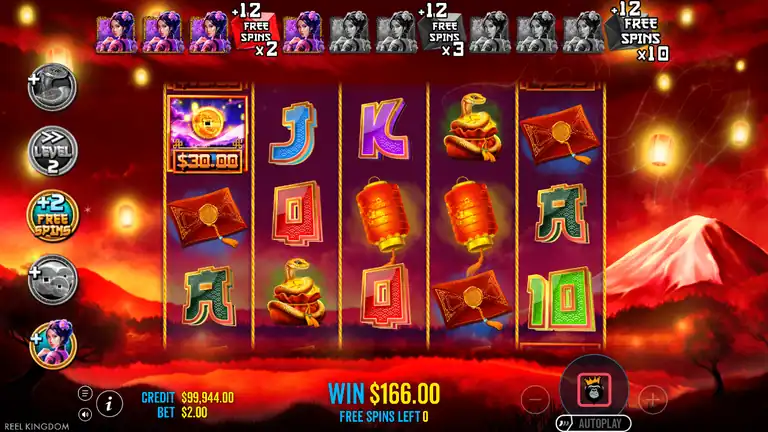
Money coins carry printed values from 2x the bet up to 5,000x, and in the base game those values are scenery. The coin itself is a line symbol there, worth 1x, 5x and 20x the bet for three, four and five on a line. The mechanic that reads the printed values runs only during the free spins. Three Dragon scatters award ten free spins, four award fifteen, and five award twenty. Once inside, a Lady wild appears across the reels, and each wild collects the value of every coin on screen at that moment. The collected coins bank into the round total, and the wilds themselves accumulate on a trail above the grid.
The trail is the engine. Every fourth wild collected does two things at once, retriggering the feature for ten more spins and advancing a multiplier that applies to the spins the retrigger adds. The first rung is x1, the second x2, the third x3, and the fourth x10. Reaching the fourth rung means gathering twelve wilds across three retriggers inside one round. The round can only end early one way, by hitting the 5,000x cap and forfeiting whatever spins remain. On paper the design is neat, a collection game with a built-in reason to keep a round alive, because every fourth wild is both more time and more money.
In the sample, the elegance runs into arithmetic. Twelve wilds in a round is a tall order when a round opens on ten or twelve spins. This whole review is really an account of how far up that trail real play tends to climb.
The base game is a waiting room
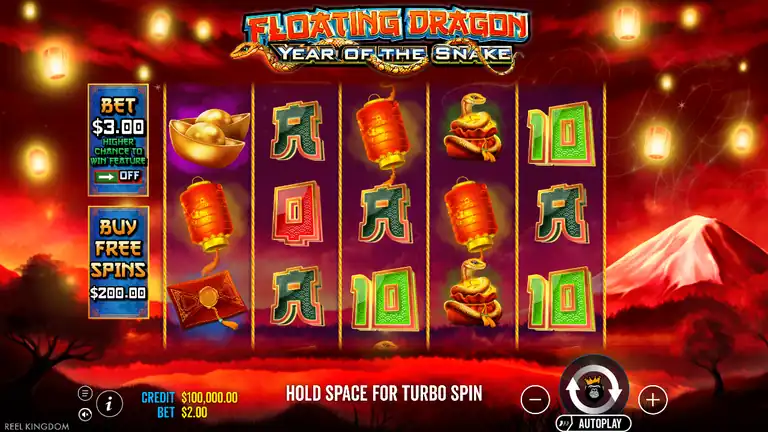
Before the trail can matter, you have to reach it, and reaching it is the least generous part of this machine. Our longest logged session ran 1,739 spins at a flat two-credit bet, and it paid something on 13.34% of them, which is more than six spins in seven returning nothing at all. The longest run without a paying spin reached forty-seven, and those aren't figures that a volatility label explains. The rules page filed the game under high volatility in May 2026, and on 8 October 2026 the public demo files it under Low. Both numbers describe a base game with no wilds, no cascades and no second feature. A line hit or a scatter is the whole of the event, and mostly neither one lands.
The coins make the waiting stranger. You can watch a 500x coin settle onto reel three with its value glowing, and it does nothing, because no wild will touch it outside the bonus. A studio fond of dangling its best symbol where you cannot use it understands anticipation better than payment. Reel Kingdom built the original Floating Dragon collector, and this Year of the Snake edition is the same skeleton with one addition, a set of pre-round modifiers I'll come to later. The base loop underneath is unchanged, a scatter hunt with the volume turned down.
Bonus frequency in our run bears that out, with thirteen scatter triggers arriving across 1,739 spins, an average of one every 134. Twelve of them played to a finish, and the thirteenth landed on the session's final logged spin and ran two of its ten free spins before the log closed. It had 14.00 on the round meter and nothing credited, so the 65.16% counts its trigger spin's stake and none of its outcome. Aggregator sheets quote a much livelier natural rate, closer to one trigger every sixty-three spins. The two sister runs came in between, at one per ninety-eight and one per hundred and sixteen. Our session simply ran cold on triggers, which is a property of one afternoon and not of the game.
Following the trail, rung by rung
Here is the finding that gives this review its spine, and in twelve finished bonus rounds our session never climbed past the second rung of the multiplier trail. Every round we logged collected its coins at x1 or x2, and the x3 and x10 levels, the two rungs that multiply a collection most, did not appear once. I checked the two rounds most able to have climbed higher against the frame archive, and both told the same story from the meter on screen.
The best round of the whole session paid 238.7x, which is 477.40 credits at the two-credit bet. It is also the largest complete bonus round anywhere in our three-session pool. The round opened on the Level Up modifier, so it started on the second rung at x2. It ran twenty-four spins after one retrigger, and gathered a string of mid-value coins including a forty and a twenty. The multiplier badge on screen read Level 2 from the first collection to the last. Nothing about that round was a climb; it was a good handful of coins collected at a modest multiplier.
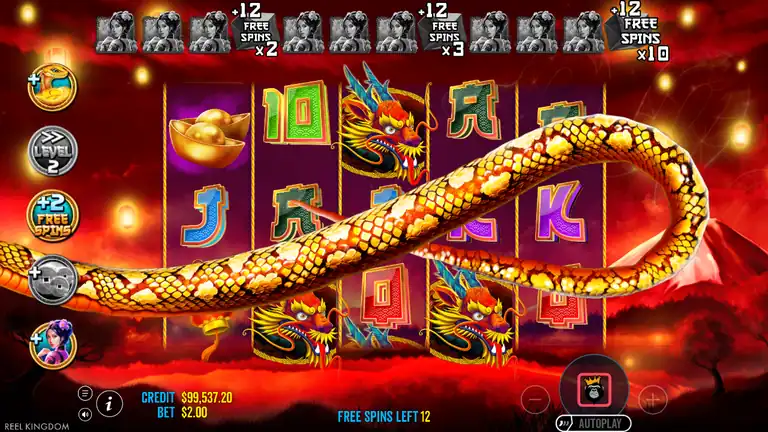
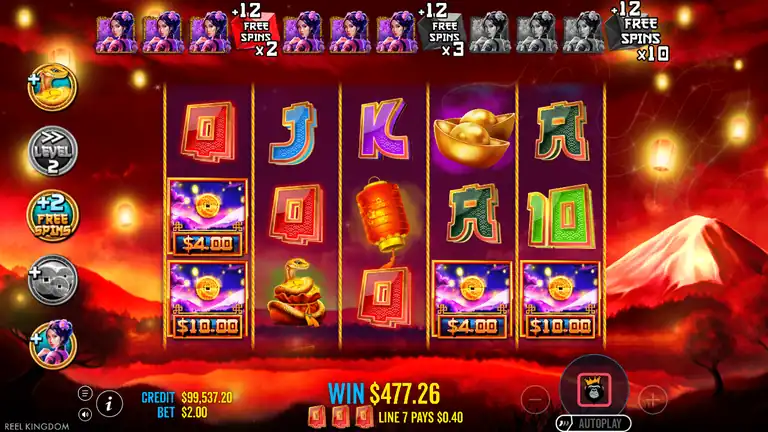
Set that beside the other round I checked. One of our rounds carried three modifiers at once, Level Up, extra free spins and more wilds, which is close to the best opening the game gives away for nothing. It should have been the round that climbed, and it closed at 58.9x. The coins it collected were small, so the same second rung produced a fraction of what the 238.7x round did on identical footing. The gap there is the whole lesson, since the multiplier level and the payout are only loosely joined, and on this evidence the coin values decide far more than the rung does.
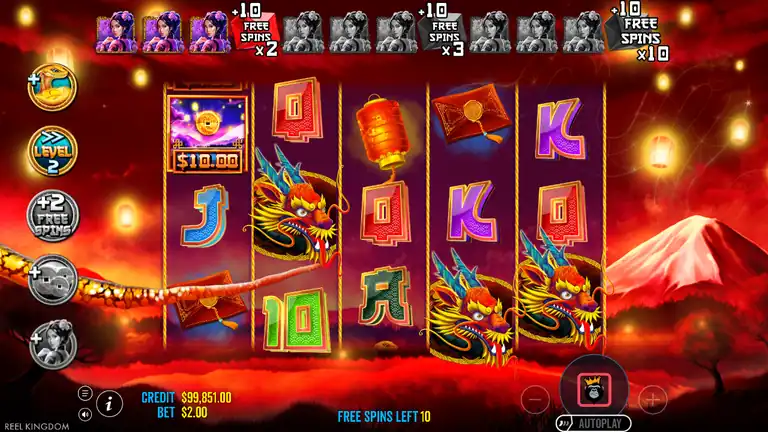
Read those two rounds together and the trail stops looking like a payout ladder and starts looking like a pacing device. It keeps a good round alive by handing back spins, and it colours the collection with a multiplier. The sum a round pays is set mostly by which coins the wilds happen to touch, while the rung only scales what is already there. It's a real design, not a broken one, and simply a narrower one than the four-rung diagram suggests.
Three sessions, and where the top of the ladder went
The SlotLab testing team logged Floating Dragon three times, once on this portal under Session ID FDS-20260809-01 and twice on the network's dedicated Floating Dragon sites. All three ran at the same flat two-credit stake, took their triggers naturally with the ante bet off, and bought no rounds, so the three ledgers pool by money. Each return is what its log had credited when it closed, and ours closed with one round open. Combined, they cover 5,136 spins and forty-five triggers, and 90.96% of everything staked had been credited when the three logs closed.
| Source | Spins | Observed return | Feature rounds | Best full round | Net result |
|---|---|---|---|---|---|
| CasinoReview.click | 1,739 | 65.16% | 13, all natural, one left open | 238.7x | −1,211.60 |
| floatingdragoncasino.com | 1,659 | 113.6% | 17, all natural | 203.0x | +449.20 |
| floatingdragonplay.com | 1,738 | 95.15% | 15, all natural | 199.4x | −168.60 |
| Combined | 5,136 | 90.96% | 45 | 238.7x | by money |
The Combined return divides the returns credited by the close of each log by the total stake across all three sessions, 9,343.00 over 10,272.00. Our own figures come from the logged session ledger, and both sister figures appear exactly as their pages publish them, including their net results. One of the forty-five triggers is the round left open at the close of the portal session, and no return figure on this page carries any of it.
CasinoReview.click Erik Lindholm's log · August 2026
floatingdragoncasino.com Alex Reeves's log · June 2026
floatingdragonplay.com Mia Stone's log · June 2026
The three cards make the pool honest about its own spread. One session ended well ahead, one landed just short of even, and ours finished a long way underwater, which is what forty-five triggers spread over five thousand spins can do. What all three share is the top rung that never showed. Alex Reeves published that no round in his seventeen reached the third rung, and Mia Stone published that hers peaked at the third rung once and never touched the fourth. Our twelve stopped at the second. Add them up, and the fourth level, x10, appeared in none of the forty-four finished rounds across the pool. It is one top rung absent from forty-four finished rounds (n = 44). The forty-fifth trigger, cut off after two free spins when the portal log closed, is not an observation of the ladder. The rung that multiplies a collection tenfold is not rare in our data; it is absent from it.
Session ID: FDS-20260809-01 · Evidence retained: 9,315 timestamped frames plus the full session log. Read the session report: FDS-20260809-01. Frames beyond its tables are available on request through the contact form. The request step is optional here: the full run is already public, checkpoint by checkpoint, as session report FDS-20260809-01.
Three things between a session and the cap
The box quotes a 5,000x maximum, and it is worth measuring the distance to it in the game's own terms rather than mine. A round reaches 5,000x when its collected total hits the cap, from any mix of coins and rungs. The shortest routes are a 500x coin at the x10 rung, a 2,500x coin at x2 or a single 5,000x coin at any rung. The coin table does list a 5,000x face, along with 2,500x and 1,666x, so the symbols exist. What has to line up is enough coin value under a high enough rung, in one round, before the spins run out.
No screen of the game prints the odds of its maximum, and the figure below comes from the game's own configuration rather than from a rules page. Its configuration puts the maximum win at about one in 3,086,876 spins in standard play, tightening to one in 1,748,252 with the ante bet on. Those are the figures behind the cap, and they mean the advertised top sits several million spins beyond a pool of five thousand. Our best reality, 238.7x, is under five per cent of it. All of these numbers are true at once, while only the small one ever touched a balance we can point to.
This is where a sister title on our own shelf earns its place. Lava Balls, also from Pragmatic, runs its multipliers out in the open, printed on the pots you can watch filling. It pays them in most bonus rounds, rather than gating them behind a collection you rarely complete. Floating Dragon keeps its multiplier on a trail you climb, and the top of that climb is the rarest thing the game owns, shown on every trigger and reached in none of our rounds. Neither approach is dishonest; one shows you the engine working, and the other shows you a diagram of an engine that mostly idles on its lower gears.
The modifiers, and the snake that helps
The one thing this edition adds over the original is a set of pre-round modifiers, drawn before the free spins begin, and they are where the design spends its cleverness. Zero to five of them can apply to a round; More Coins seeds extra money symbols, More Ladies seeds extra wilds, and Level Up starts the trail on the second rung. Extra Free Spins adds two spins at entry and two more per retrigger, and a group covering dynamites, snakes and firecrackers raises the chance of the in-round helpers. When several land together, a round can open on x2 with more coins and more wilds already in play, which is exactly the setup our best two rounds had.
Inside the round, three more helpers fire at random, and they exist to stop a round from stalling. A dynamite adds money symbols when wilds are present with nothing to collect. A snake pulls a reel to bring in a wild when coins are present with nothing to collect them. A firecracker transforms every non-wild symbol for a fresh look at a collection. There is even a base-game rescue. Landing two scatters without a third lets a random feature nudge or drag the third onto the reels, which is how a few of our triggers arrived. It's a thoughtful layer, and it explains why the bonus feels busy even when it pays little. The helpers keep the collection moving, but they do not change how high the trail tends to go.
The return figure, printed and configurable
Credit where it is due, this build prints its RTP, and prints it in three places that agree. The rules screen states a theoretical 96.71% for standard play, the same 96.71% with the ante bet running, and the same figure again for a bought round. The entry method does not move the maths, and this is more transparency than several games on this portal manage, and it should be said plainly.
Then comes the catch downstream, because Pragmatic ships this title in more than one configuration, and both sister reviews recorded operator variants at 95.67% and 94.60% alongside the headline rate. The 96.71% you see in the demo is the version the studio prints, not a promise about the version a given casino has switched on. Our pooled 90.96% sits below all of those published rates, the expected shape for a five-thousand-spin sample weighed down by one cold session. The figure stays a session outcome rather than a property of the game.
Editor's note: reading the RTP numbers. Stated RTP for this title is printed in the game's rules screen and published by Pragmatic Play on its game page: a long-run average taken over millions of spins. Our tested figure is the pooled return of the logged demo sessions behind this review, so the two numbers answer different questions, and even a pooled sample of a few thousand spins is not the game's long-run maths. Live RTP is an operator choice: many games ship in several RTP configurations and the casino picks which one to run, so always check the RTP in the game's info screen before you bet real money. More in our guide to stated vs observed RTP.
Ante and buy: two ways to pay for the trigger
Two levers change how you meet the feature, and both keep the same return. The ante bet raises the cost of every spin by half, seeds more scatters and lifts the natural trigger rate, and while it is on, the buy option disappears from the menu, since the two are mutually exclusive. The buy runs the other way, dropping you into a round for 100x the current bet, with the triggering spin randomly producing three, four or five scatters. It vanishes from the menu wherever the ante is active.
Neither lever touches the ladder. A bought round starts at the first rung like any other and climbs on the same fourth-wild rule, so paying 100x buys you a trigger, not a multiplier. Since our whole pool never reached the fourth rung on natural play, the honest way to read the buy is as a shortcut past the base game's waiting, not a route to the numbers on the box. Our sessions used neither lever, which is why the trigger rates above are the game's own, unpurchased.
What the ledger suggests
- Budget for the wait, not the ladder. The base game paid on about one spin in seven and a half for us, with a longest silence of forty-seven. At a flat stake that is a long stretch of nothing between features, and it is where a bankroll actually goes.
- Price the coins, not the multiplier. Our best round and our stalled round stood on the same rung, and the difference was the coin values collected. Judge a round by the faces the wilds touch, since the multiplier only scales what is already there.
- Count on the bottom of the ladder. Across forty-four finished rounds in three logs the x10 level never came once. The maximum win, timed by the game's configuration at one in three million spins, is a round total of 5,000x, and the rules print no odds for any route there. It is a real part of the maths and an unlikely part of an evening.
- Confirm the return where you play. The demo prints 96.71%, but operator variants at 95.67% and 94.60% exist, and the demo answers every mechanical question for nothing while the real rate stays a lobby detail. The 18+ rule holds in demo play as well.
The demo and the other two logs
We test on the provider's public demo, because a logged run leaves a ledger anyone can audit. A review that makes claims about a rarely-seen multiplier owes you the record behind them. The build opens right in the page on our shelf, with no pop-up involved. Two more Floating Dragon ledgers live on the network's dedicated sites, both with playable demos beside them. Read Alex Reeves at floatingdragoncasino.com for the seventeen-round session that finished ahead, or Mia Stone at floatingdragonplay.com for the fifteen-round log that reached the third rung once. Everything quoted from either site appears in this review exactly as they publish it.
The coin ladder runs in the page on the Floating Dragon demo page, on the build that handed me 65.16%. The Demo Shelf carries every other build we have logged, cards side by side. The full paytable and the fine print of this build, every value priced, live on the Floating Dragon rules page.
Floating Dragon Snake FAQ
What is the RTP of Floating Dragon: Year of the Snake?
The build prints a theoretical 96.71%, and the rules screen shows that same rate for standard play, the ante bet and the buy feature alike. Operator-configured variants at 95.67% and 94.60% also exist, so the figure in a real-money lobby depends on the casino. Our three-session demo pool had returned 90.96% by money over 5,136 spins when its logs closed, one round still open, which is one sample and not the game's maths.
How does the multiplier work in Floating Dragon?
During free spins, wild symbols collect the values of money coins on screen. Every fourth wild collected retriggers the feature for ten more spins and advances a multiplier from x1 to x2 to x3 to x10. The new level applies to the added spins, and reaching the top level, x10, requires twelve wilds in a single round, which is why it is so rarely seen.
How rare is the 5,000x maximum win?
The odds are very long, because a round has to collect 5,000x in total. The shortest routes there are a 500x coin at x10, a 2,500x coin at x2 or a single 5,000x coin. The build's own configuration times the top win at about one in 3,086,876 spins in standard play, or one in 1,748,252 with the ante bet on. Across our pool of 5,136 spins the best full round was 238.7x, under five per cent of the cap.
Are the money coins worth anything in the base game?
In the base game the coin is an ordinary line symbol, worth 1x the bet for a line of three, 5x for four and 20x for five. The value printed on its face is display only there, and nothing collects it until the free spins arrive and the wilds appear. Every base-game payout comes from line wins on the ten fixed lines.
Is the Buy Free Spins option worth its price?
The buy costs 100x the bet and drops you into a round with three, four or five scatters. It saves you the base game's long wait, but a bought round still climbs the same trail as a natural one, starting at the first rung. The buy gets you a trigger rather than a higher multiplier, and given that our pool never reached the top rung on any trigger, it is a shortcut, not a route to the cap.
Can I play Floating Dragon for free?
Yes, and the Pragmatic Play demo runs on a virtual balance straight from our Demo Shelf, in the page rather than a pop-up, with the full rules screens inside. A few hundred spins will show you the collection mechanic and the pace of the triggers without any money at stake. The 18+ rule applies in demo play exactly as it does with real money.
My reading
Floating Dragon: Year of the Snake earns its 6.7 for a mechanic that is clear and a base game that is dull. A top rung that reads more like decoration than payout holds the score down. The collection idea is legible, the modifiers give the bonus a pleasant busyness, and the studio deserves the credit it rarely gets elsewhere for printing its RTP three times over. Against that sits a base game that pays on one spin in seven and a half, and money coins whose printed values wait for the feature. Above them sits a four-rung ladder whose top rung our pool of forty-four rounds never reached and whose third rung it reached once. The game's configuration times the maximum win at one in three million spins, by whatever mix of coins and rungs reaches it, and no screen shows the player that figure. Everything below it is decided by which coins the wilds happen to find. The printed return puts it level with Royal Joker, 6.7, which pairs a base as quiet with a build that prints nothing. It is a competent collector fitted with a maximum it has almost no way to reach, and the honest way to enjoy it is for the climb, not the summit.
Corrections and updates
- Sep 17, 2026. The hit frequency of this portal's session read 15.12%, and the longest no-win run read 33 spins. The count behind both included 31 settlements of 0.00, left by a base-game modifier that added nothing. Counted as paid spins that returned anything the figures are 13.34%, 232 of 1,739, and 47 spins, and the session card, the text and the session report now carry them. No return, round or checkpoint changed, and the score is unchanged.
- Sep 17, 2026. Score moved from 6.5 to 6.7. When the scoring rubric was published, all fifteen scores were compared with their neighbours on what each build prints and on how its base game pays. This build prints its return three times and the odds of its own maximum, the fullest disclosure on our shelf, and it had stood below a machine that prints nothing and has no feature. The deductions for the base game and for the decorative top rung are unchanged, and the closing section now names the neighbour it sits level with under How we score. No session figure changed.
- Sep 18, 2026. The overview said that reaching the fourth rung takes sixteen wilds, and the rules say twelve, as the rest of this page does. The session paragraph, the pool table and its note now say that the thirteenth trigger of the portal session was left open when the log closed, two of its ten free spins played and nothing credited, and that neither the 65.16% nor the pooled 90.96% carries any of it. No figure changed, and the score is unchanged.
- Sep 18, 2026. The pool section, its note and the FAQ now call the 65.16% and the pooled 90.96% what they are, the returns credited by the close of each log, because ours closed with a round open. The absent top rung is counted over the forty-four finished rounds, and the cut-off trigger is set aside as no observation of the ladder. No figure changed, and the score is unchanged.
- Sep 18, 2026. Three sentences had tied the 5,000x maximum to the x10 rung alone. The rules give two routes, the x10 rung with a 500x-or-higher coin or a single 5,000x coin at any level, and the overview, the bankroll notes and the closing section now say so, as the maximum section and the FAQ already did. No figure changed, and the score is unchanged.
- Sep 18, 2026. Four more places had tied the 5,000x maximum to the top rung, and the earlier entry today had called two routes to it exhaustive. The cap is a round total, and any mix of coins and rungs that reaches 5,000x ends the round. A 500x coin at x10, a 2,500x coin at x2 or a single 5,000x coin are the shortest routes. The lead, the maximum section, the FAQ, the bankroll notes and the closing section now say so. No figure changed, and the score is unchanged.
- Oct 8, 2026. The feature section and one FAQ answer said that a stepped multiplier applies to all future coin collection. The rules print that it applies to the retriggered spins, which are played after the current batch ends, and two rounds in a sister log show a wild collecting at the old rung in between. Both now say so. No figure changed, and the score is unchanged.
- Oct 8, 2026. The volatility label on the rules page has changed since this review was written. The screens we archived on 24 May 2026 carry a five-bolt meter and the line that high volatility games pay out less often. On 8 October 2026 the fifth page of the public demo's rules reads Low volatility instead. The card now leads with Low and keeps the May reading, High, after it, and the sources table dates both. One sentence of the base-game section no longer calls the game a high-volatility title, and no session figure or score changed.
- Oct 9, 2026. This review said the build prints the odds of its own maximum, and no rules page, intro screen or board prints them. The figure, one in 3,086,876 spins, is carried in the game's configuration, where the player never sees it, and every Pragmatic Play game on our shelf carries one. The sources table, the cap section and the closing now say so. The 6.7 stays, on the reason that survives, a return printed three times for standard play, the ante bet and the buy. The review also said that money coins pay nothing in the base game. The coin is an ordinary line symbol there, worth 1x, 5x and 20x the bet, and only its printed value waits for the free spins. The lead, the feature section, one FAQ answer and the closing are corrected. The closing also said the pool never reached the top two rungs, and it reached the third once, in the floatingdragonplay.com log. Four lines that called the x10 rung the fastest or shortest way to the maximum no longer rank the routes, since the rules print no odds for any of them. No session figure changed.
Report an error: use the contact form and mention Floating Dragon: Year of the Snake and Session ID FDS-20260809-01.

Former studio-side game mathematician: paytables and RTP models, now checked from the player's side. Full profile and method →